

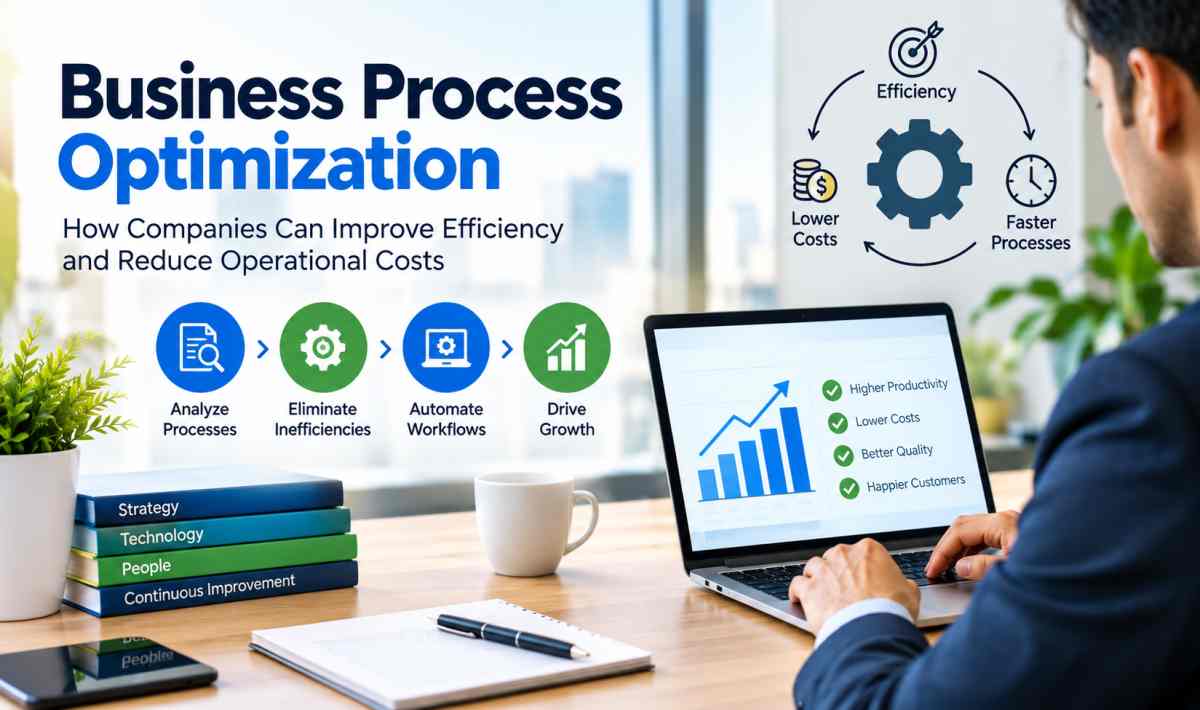
Business Process Optimization: How Companies Can Improve Efficiency and Reduce Operational Costs
In today’s competitive business environment, companies must continuously find ways to improve efficiency, reduce expenses, and deliver better customer experiences. Rising operational costs, changing customer expectations, and rapid technological advancements have made it increasingly important for organizations to evaluate how they manage their daily activities. One of the most effective ways to address these challenges is through business process optimization.
Business process optimization involves analyzing existing workflows, identifying inefficiencies, and implementing improvements that help organizations achieve better results with fewer resources. By optimizing business processes, companies can eliminate unnecessary tasks, reduce operational waste, improve employee productivity, and make better use of technology.
From small businesses and startups to large enterprises, organizations across industries can benefit from more efficient processes. Whether a company wants to improve customer service, streamline inventory management, automate administrative tasks, or reduce production costs, process optimization provides a practical framework for achieving sustainable growth.
In this guide, we will explore what business process optimization means, why it matters, the strategies companies can implement, and how modern technology is transforming the way businesses operate.
What Is Business Process Optimization?
Business process optimization is the systematic improvement of business activities to make them faster, more cost-effective, reliable, and productive. It focuses on understanding how work is currently performed and finding opportunities to improve the way tasks move through an organization.
Every company depends on processes to complete its daily operations. These processes may include sales, marketing, customer support, recruitment, purchasing, accounting, manufacturing, and order fulfillment.
However, processes that worked well when a business was small may become inefficient as the company grows. Employees may spend too much time on repetitive tasks, departments may struggle to share information, and outdated systems may create unnecessary delays.
Business process optimization addresses these problems by examining workflows, removing bottlenecks, simplifying procedures, and introducing better tools where appropriate.
For example, a company that manually processes hundreds of customer orders may experience delays and data-entry errors. By introducing an integrated order management system, the company can automate routine activities, improve accuracy, and process orders more quickly.
The objective is not simply to make employees work faster. It is to create processes that help people and technology work together more effectively.
Why Is Business Process Optimization Important?
Efficient processes are essential for businesses that want to remain competitive and financially sustainable. Without regular improvements, unnecessary expenses and operational problems can gradually reduce profitability.
Here are some important reasons why business process optimization matters.
1. Reduces Operational Costs
One of the biggest advantages of process optimization is its potential to reduce operating expenses. Inefficient workflows often involve duplicated work, excessive paperwork, unnecessary approvals, and wasted resources.
By identifying these problems, companies can simplify operations and use their budgets more effectively.
For example, automating invoice processing can reduce manual data entry and minimize the time employees spend handling routine financial tasks. Similarly, better inventory planning can help businesses avoid excessive stockholding and reduce storage expenses.
2. Improves Employee Productivity
Employees perform better when their responsibilities are clearly defined and their tools support their work.
Complicated approval systems, outdated software, and repetitive administrative tasks can prevent employees from focusing on more valuable activities.
Optimized processes remove unnecessary steps and give employees more time to concentrate on customer relationships, problem-solving, planning, and innovation.
3. Enhances Customer Satisfaction
Customers expect businesses to provide reliable services, accurate information, and timely responses.
Inefficient processes can lead to delayed deliveries, incorrect orders, slow customer support, and inconsistent service quality.
By improving workflows, businesses can respond faster, reduce mistakes, and create smoother customer experiences.
4. Supports Business Growth
As companies expand, their operational requirements become more complex. Processes that depend entirely on manual work may struggle to handle increasing demand.
Business process optimization helps organizations build repeatable systems that can support growth without requiring a proportional increase in administrative effort.
5. Improves Decision-Making
Optimized processes often include better data collection, reporting, and performance monitoring.
Managers can use this information to understand where resources are being spent, identify recurring problems, and make informed decisions about future investments.
Common Signs That Your Business Processes Need Improvement
Before implementing changes, companies should identify the operational problems affecting their performance.
Several warning signs indicate that existing workflows may need optimization.
Frequent delays: Tasks regularly miss deadlines because of complicated approvals, unclear responsibilities, or poor coordination.
High operating expenses: Business costs continue increasing without a corresponding improvement in output or service quality.
Repeated errors: Employees frequently correct inaccurate records, duplicate entries, billing mistakes, or incomplete orders.
Excessive manual work: Staff members spend significant time copying information between systems, preparing routine reports, or completing repetitive administrative tasks.
Poor communication: Departments work with inconsistent information, causing confusion and unnecessary delays.
Customer complaints: Customers experience slow responses, unreliable delivery times, or inconsistent service.
Limited visibility: Managers cannot easily determine how long processes take, where problems occur, or which activities consume the most resources.
Recognizing these warning signs allows businesses to prioritize improvements that can deliver meaningful operational benefits.
Effective Strategies for Business Process Optimization
Companies can use several approaches to improve their operations. The most suitable strategy depends on the organization’s size, industry, available resources, and business objectives.
1. Analyze Existing Business Processes
The first step is understanding how work currently gets done.
Businesses should document important workflows, including the people involved, systems used, approvals required, and time needed to complete each activity.
Process mapping is a useful technique for visualizing these steps. It helps managers identify duplicated activities, unnecessary handoffs, long waiting periods, and other inefficiencies.
For example, a purchasing process might require several approvals for routine, low-value purchases. Reviewing the workflow may reveal that some approvals can be combined or delegated while maintaining appropriate financial controls.
Companies should also speak with employees who perform the work daily. Their practical experience can reveal problems that are not obvious from management reports.
2. Set Clear and Measurable Goals
Optimization efforts are more effective when companies define what success looks like.
Instead of setting a general objective such as improving productivity, businesses should establish measurable targets.
Examples include:
- Reducing invoice processing time by 25%.
- Shortening customer response times.
- Decreasing order processing errors.
- Reducing inventory waste.
- Improving on-time delivery rates.
- Lowering the average cost of completing a transaction.
These are illustrative targets, not guaranteed outcomes.
Clear objectives help teams prioritize initiatives, measure progress, and determine whether an improvement is delivering the expected value.
3. Eliminate Unnecessary Steps
Many business processes become complicated because additional procedures are introduced over time without reviewing whether they remain necessary.
Optimization provides an opportunity to remove activities that do not contribute meaningful value.
Companies can simplify approval structures, standardize documentation, reduce duplicate data entry, and clarify responsibilities.
However, removing steps should not mean eliminating essential safeguards. Financial controls, privacy protections, quality checks, and regulatory requirements must remain in place.
The goal is to create a simpler process without increasing business risk.
4. Automate Repetitive Tasks
Automation is one of the most practical ways to improve business efficiency.
Modern automation tools can handle repetitive activities such as sending appointment reminders, generating invoices, updating customer records, scheduling reports, and routing support requests.
For example, a service company can use workflow automation to assign incoming customer inquiries to the appropriate department. This reduces manual coordination and helps employees respond more consistently.
Robotic process automation can also perform rule-based tasks across existing software systems, particularly when direct integration is unavailable.
Before automating a workflow, businesses should first simplify it. Automating an inefficient process can make mistakes happen faster rather than solve the underlying problem.
5. Adopt Cloud-Based Business Software
Disconnected software systems can create information gaps, duplicated records, and unnecessary administrative work.
Cloud-based platforms can help teams access shared information, collaborate remotely, and manage business activities through centralized systems.
Depending on business needs, companies may benefit from customer relationship management software, enterprise resource planning systems, accounting applications, project management platforms, and inventory management tools.
Integrated systems reduce the need to transfer information manually between applications.
When selecting software, businesses should consider usability, security, integration capabilities, scalability, ongoing costs, and employee training requirements.
6. Improve Communication Between Departments
Operational inefficiencies often occur when departments operate independently.
For example, the sales team may promise a delivery date without checking inventory availability, or the finance department may lack information required to approve a purchase.
Companies can reduce these problems by defining shared workflows, establishing clear responsibilities, and creating consistent communication channels.
Regular cross-functional meetings, centralized dashboards, documented procedures, and shared project management tools can improve coordination.
Better communication helps employees identify problems earlier and prevents avoidable delays.
7. Use Data Analytics to Identify Bottlenecks
Business process optimization becomes more effective when decisions are supported by reliable data.
Organizations can analyze processing times, error rates, labor costs, customer complaints, resource utilization, and other operational indicators to identify where improvements are needed.
For instance, data may reveal that customer orders are processed quickly but remain delayed during dispatch. This indicates that the main problem may involve warehouse scheduling or delivery coordination rather than order entry.
Dashboards and reporting tools help managers monitor performance and identify unusual patterns.
Businesses should collect only the information they need, maintain data quality, and protect sensitive information appropriately.
8. Invest in Employee Training
New systems and redesigned workflows are only effective when employees understand how to use them.
Organizations should provide practical training whenever processes, responsibilities, or technologies change.
Training can cover new software, standardized procedures, customer communication, data management, and problem-solving techniques.
Employees should also have opportunities to share feedback and suggest improvements.
When staff members understand why changes are being introduced, they are more likely to adopt new practices and help maintain long-term improvements.
The Role of Artificial Intelligence in Business Process Optimization
Artificial intelligence is creating new opportunities for companies to improve operational performance.
Traditional automation generally follows predefined rules, while AI tools can also analyze information, recognize patterns, summarize documents, and assist with certain decisions.
Several applications are particularly useful for business process optimization.
Intelligent document processing: AI-powered tools can extract information from invoices, forms, contracts, and other documents, reducing manual data entry. Important information may still require human verification.
Customer service automation: AI assistants can answer common questions, summarize support conversations, and route complex requests to the appropriate employees.
Predictive analytics: Machine learning systems can analyze historical information to help businesses forecast demand, anticipate maintenance requirements, and plan inventory.
Workflow assistance: AI tools can summarize reports, organize information, draft routine communications, and help employees complete administrative work.
Quality monitoring: Depending on the application, AI can help identify unusual transactions, inconsistencies, or potential quality problems for further investigation.
Despite these advantages, AI should not be adopted simply because it is a popular technology. Businesses must evaluate accuracy, privacy, security, implementation costs, and the consequences of incorrect outputs.
Human oversight remains important, especially for financial decisions, legal matters, employment decisions, and other high-impact activities.
The most effective approach is to combine AI capabilities with clear business rules, appropriate controls, and employee expertise.
How to Measure the Success of Process Optimization
Businesses need reliable performance indicators to determine whether optimization initiatives are producing results.
The most useful metrics depend on the process being improved.
Operational Cost Per Transaction
This metric measures the average cost of completing a particular activity, such as processing an order or resolving a support request.
A reduction may indicate improved efficiency, provided service quality remains acceptable.
Process Completion Time
This measures how long a process takes from beginning to end.
Shorter completion times can indicate that unnecessary steps and delays have been removed.
Error Rate
Tracking the frequency of mistakes helps businesses evaluate whether redesigned processes improve accuracy.
Companies should monitor both the number of errors and the cost of correcting them.
Employee Productivity
Productivity measures can help organizations understand how efficiently resources are being used. They should be selected carefully to avoid encouraging employees to prioritize speed over quality.
Customer Satisfaction
Customer feedback, complaint rates, repeat purchases, and service ratings can help reveal whether operational changes are improving the customer experience.
Return on Investment
Businesses should compare the financial benefits of an optimization project with its implementation and ongoing costs.
For example, a project that reduces administrative expenses may also require software subscriptions, employee training, system integration, and maintenance.
Calculating these costs provides a more realistic picture of the project’s value.
A Practical Example of Business Process Optimization
Consider a growing e-commerce company that receives hundreds of orders daily.
Initially, employees manually enter orders, update inventory spreadsheets, prepare invoices, and notify customers about shipping. As sales increase, the company begins experiencing processing delays, inventory discrepancies, and customer complaints.
The company decides to optimize its order fulfillment process.
First, managers map the existing workflow and identify duplicated data entry and delayed inventory updates.
Next, the company introduces an integrated order management system connected to its inventory and accounting software.
Routine order confirmations and shipping notifications are automated. Employees receive training on the new system, while managers establish performance indicators to monitor fulfillment times and errors.
Over time, the company can compare its operating costs, processing speed, and customer feedback against the original baseline.
The actual results depend on implementation quality, order volume, software costs, and other operational factors.
Nevertheless, this example illustrates how targeted improvements can address several business problems without requiring every activity to be redesigned at once.
Common Challenges in Business Process Optimization
Although process optimization offers significant opportunities, businesses may encounter obstacles during implementation.
Resistance to Change
Employees may worry about unfamiliar systems, changing responsibilities, or job security.
Companies can address these concerns through transparent communication, employee involvement, and appropriate training.
High Initial Investment
Some improvements require new software, system integration, consulting, or infrastructure upgrades.
Businesses should prioritize projects according to their expected benefits, implementation costs, and operational risks.
Poor Data Quality
Inaccurate or inconsistent data can undermine analytics, automation, and reporting.
Organizations should establish clear data standards and assign responsibility for maintaining important records.
Overcomplicated Technology
Introducing too many tools can create additional complexity rather than improve efficiency.
Companies should select technologies that address specific problems and integrate with existing systems wherever practical.
Lack of Continuous Monitoring
A process that performs well today may become inefficient as customer expectations, regulations, and business requirements change.
Regular performance reviews help organizations identify new problems and maintain improvements.
Best Practices for Long-Term Business Process Improvement
Successful optimization should be treated as an ongoing management activity rather than a one-time project.
Companies can support continuous improvement by following several principles:
- Review important workflows regularly.
- Use measurable objectives to guide decisions.
- Involve employees who understand daily operations.
- Prioritize improvements that address genuine business problems.
- Test major changes on a small scale before expanding them.
- Protect customer information and maintain necessary controls.
- Monitor results and adjust processes when circumstances change.
- Document successful procedures so improvements remain consistent.
Some organizations also use established improvement approaches such as Lean management, Six Sigma, and the Plan-Do-Check-Act cycle.
These methods provide structured ways to reduce waste, address process variation, test improvements, and maintain operational standards.
The appropriate approach depends on the complexity of the process and the organization’s available resources.
Future Trends in Business Process Optimization
Business process optimization will continue to evolve as technology and business expectations change.
AI-powered workflows are likely to become more capable of coordinating routine tasks across connected business applications. Predictive analytics will continue helping organizations plan resources and anticipate operational problems.
Low-code and no-code platforms may also make it easier for teams to build simple workflows without extensive software development.
Meanwhile, businesses will place greater emphasis on cybersecurity, responsible AI adoption, employee experience, and sustainable resource utilization.
Another important trend is the integration of business systems. Instead of managing information through separate applications, organizations increasingly seek connected workflows that allow data to move between departments with less manual intervention.
However, successful optimization will still depend on sound management principles. Technology can support better operations, but it cannot compensate for unclear objectives, poor process design, or a lack of accountability.
Companies that combine practical process improvements with appropriate digital tools will be better positioned to respond to changing market conditions.
Conclusion
Business process optimization is an important strategy for companies that want to improve efficiency, reduce operational costs, and strengthen their competitive position.
By examining existing workflows, eliminating unnecessary steps, automating repetitive tasks, improving communication, and using data to guide decisions, organizations can create more productive operations.
Modern technologies such as cloud computing, artificial intelligence, workflow automation, and data analytics provide additional opportunities to streamline work and improve business performance.
However, successful optimization requires more than purchasing new software. Companies must set clear objectives, involve employees, maintain appropriate controls, and measure the results of every significant improvement.
The best starting point is to identify one process that creates frequent delays, unnecessary expenses, or customer complaints. Analyze the problem, test a practical solution, and measure the outcome before expanding the approach.
Ultimately, business process optimization is not simply about doing more work in less time. It is about creating smarter, more reliable, and more sustainable ways of working that support long-term business growth.
Frequently Asked Questions (FAQs)
1. What is business process optimization?
Business process optimization is the practice of analyzing and improving business workflows to increase efficiency, reduce unnecessary costs, minimize errors, and improve overall performance.
2. How can companies reduce operational costs through process optimization?
Companies can reduce operational costs by automating repetitive activities, eliminating duplicated work, improving resource allocation, integrating software systems, and reducing errors and waste.
3. What tools are used for business process optimization?
Common tools include workflow automation platforms, business process management software, project management applications, customer relationship management systems, enterprise resource planning software, and data analytics dashboards.
4. How does AI help optimize business processes?
AI can assist with document processing, customer service, demand forecasting, information analysis, workflow coordination, and identifying unusual patterns. Human review remains important for sensitive or high-impact decisions.
5. Is business process optimization suitable for small businesses?
Yes. Small businesses can benefit from simple improvements such as automating invoices, standardizing procedures, organizing customer information, improving inventory tracking, and reducing unnecessary administrative work.
6. How often should business processes be reviewed?
Businesses should monitor important processes regularly and conduct more detailed reviews when costs increase, performance declines, customer needs change, or new technologies become available.
7. What is the main goal of business process optimization?
The main goal is to make business operations more efficient, cost-effective, consistent, and adaptable while maintaining service quality, employee effectiveness, and customer satisfaction.