

Here is a detailed, SEO-friendly article focused on the major plant science and smart agriculture developments shaping 2026.
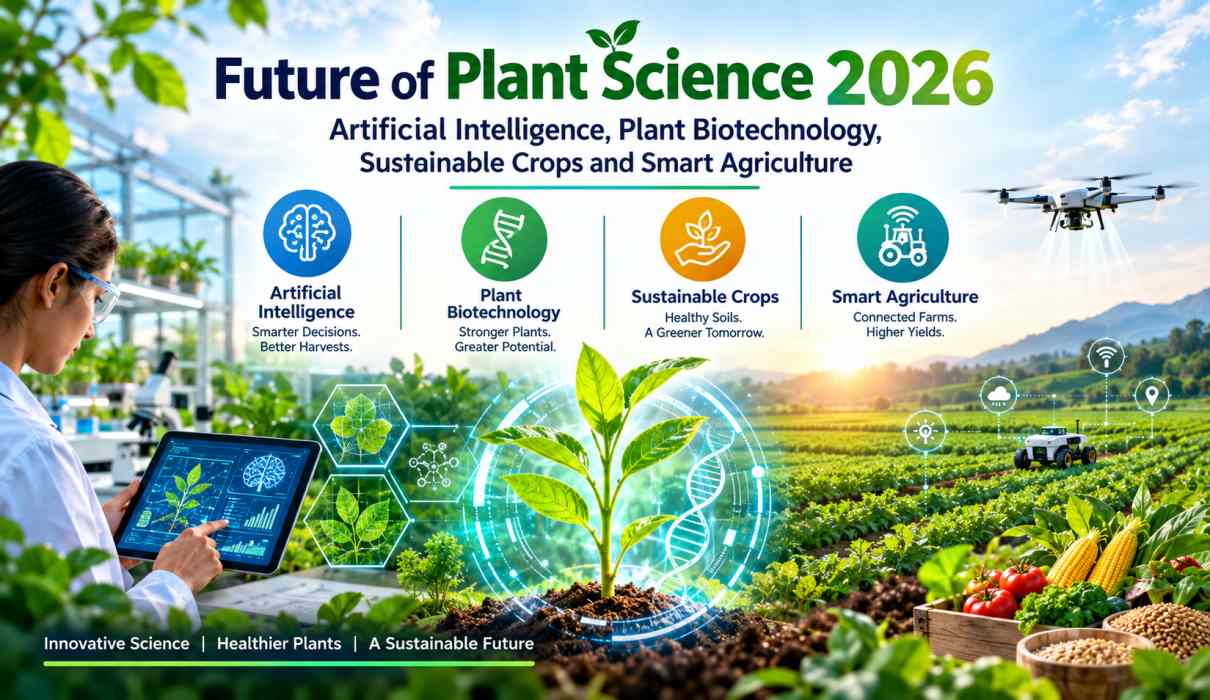
Future of Plant Science 2026: Artificial Intelligence, Plant Biotechnology, Sustainable Crops and Smart Agriculture
Plant science is entering a new era in 2026. Advances in artificial intelligence, genomics, gene editing, biotechnology, sensors and data analytics are changing how scientists understand plants and how farmers develop and manage crops. At the same time, climate change, water scarcity, soil degradation, biodiversity concerns and increasing food demand are creating new challenges for agriculture.
The future of plant science in 2026 is therefore focused on developing crops that are more productive, nutritious, resource-efficient and resilient to environmental stress. Instead of relying only on traditional breeding and field trials, researchers are increasingly combining molecular biology with AI, high-throughput phenotyping, multi-omics, precision agriculture and digital technologies.
Recent research shows that the combination of AI and genome editing could move crop improvement toward more predictive design, helping researchers identify promising genetic changes and then experimentally validate them. However, scientists also emphasize that biological complexity, limited training data and regulatory differences remain important challenges.
From AI-powered crop breeding and CRISPR gene editing to smart irrigation, plant bioelectronics and climate-resilient crops, these developments could significantly influence agriculture over the coming decade.
1. Artificial Intelligence Is Transforming Plant Science
Artificial intelligence is becoming one of the most important technologies in modern plant science. Researchers can use machine learning to analyze enormous quantities of information generated from plant genomes, images, environmental sensors and field experiments.
Traditional agricultural research can require years of testing to understand how a particular crop variety responds to different environments. AI can help researchers analyze patterns across large datasets and identify relationships between genetics, environmental conditions and plant performance.
AI applications in plant science include:
- Crop disease identification
- Plant image analysis
- Yield prediction
- Crop selection
- Soil analysis
- Pest detection
- Irrigation optimization
- Trait prediction
- Breeding decisions
- Climate-risk modelling
In 2026, researchers are also exploring more autonomous agricultural decision-support systems. A Scientific Reports study described an AI-driven system designed to support soil classification, crop recommendations and fertilizer recommendations.
The growing use of AI does not mean that farmers or plant scientists will simply be replaced by algorithms. Instead, AI can provide additional information that helps experts make better-informed decisions.
2. AI-Powered Crop Breeding
Crop breeding is one of the areas where AI could have a particularly significant impact.
Breeders traditionally select plants based on observable characteristics such as yield, disease resistance, plant height, maturity and grain quality. Modern breeding increasingly adds genomic information to this process.
AI can analyze relationships between genetic variation and desirable traits, potentially helping researchers identify promising breeding candidates more efficiently.
The emerging combination of AI, genomics and high-throughput phenotyping is moving crop breeding toward a data-intensive model. Instead of evaluating only a small number of characteristics manually, researchers can collect information about thousands of plants using cameras, drones, sensors and molecular technologies.
The goal is to predict which plants are most likely to perform well under specific environmental conditions.
This is particularly important for climate-resilient agriculture because a crop that performs well in one environment may not necessarily perform equally well under heat, drought or water stress.
3. CRISPR and Precision Plant Biotechnology
Gene editing remains one of the most important developments in plant biotechnology.
CRISPR-based technologies allow researchers to make targeted changes to DNA. Newer approaches, including base editing and prime editing, are expanding the possibilities for modifying genetic sequences with increasing precision.
Research published in 2026 highlights the potential of CRISPR/Cas9 and related technologies for improving crop yield, nutritional quality, disease resistance and tolerance to environmental stress.
Potential applications include developing crops with:
- Improved disease resistance
- Greater drought tolerance
- Better heat tolerance
- Enhanced nutritional characteristics
- Improved shelf life
- More efficient resource use
- Modified plant architecture
- Reduced susceptibility to certain pests
One of the most interesting developments is the combination of AI and genome editing. AI can help predict which genetic changes may produce useful traits, while genome editing provides a way to experimentally test those predictions. Researchers describe this as a potentially iterative cycle between computational prediction and biological validation.
Nevertheless, gene editing is not a universal solution. Crop biology is complex, and genetic changes can interact with environmental conditions in unexpected ways. Regulatory frameworks and public acceptance also differ between countries.
4. Climate-Resilient Crops Are a Major Priority
Climate resilience is becoming central to plant science.
Agricultural systems face changing temperatures, irregular rainfall, drought, flooding, salinity and shifting pest and disease pressures. These factors can affect crop productivity and food security.
Plant scientists are therefore searching for varieties capable of maintaining acceptable performance under challenging conditions.
Drought-resilient crops are receiving particular attention. Recent research has explored how metabolomics, AI and gene-editing technologies can be combined to understand and engineer plant responses to drought.
Scientists are also studying how crops respond to combinations of stresses rather than individual stresses. In real agricultural environments, plants may experience heat, drought, salinity, nutrient limitations and disease simultaneously.
This creates a need for more sophisticated models that understand interactions between genes, environmental conditions and management practices.
The future of plant science is consequently moving toward climate-aware crop design, where resilience is considered from the earliest stages of breeding.
5. Multi-Omics Is Creating a Deeper Understanding of Plants
Another important trend is the growing use of multi-omics.
Plant scientists can study different biological layers, including:
- Genomics
- Transcriptomics
- Proteomics
- Metabolomics
- Epigenomics
- Phenotypic data
When these datasets are combined, researchers can gain a more complete picture of how plants function.
For example, researchers may investigate which genes become active during drought, how proteins respond, which metabolites change and how those molecular changes affect visible plant characteristics.
AI and machine learning can help integrate these large and complex datasets.
This approach could contribute to faster identification of biological pathways associated with desirable traits and provide new opportunities for precision crop engineering.
6. Smart Agriculture Is Connecting Plants With Digital Technology
Smart agriculture combines farming with sensors, IoT devices, AI, robotics, satellite imagery, automation and data analytics.
The concept is based on measuring agricultural conditions more precisely and responding to them more efficiently.
Instead of treating an entire field in exactly the same way, precision agriculture can help identify differences in soil moisture, crop health and nutrient requirements.
Sensors can collect information about soil moisture and environmental conditions. Cameras and drones can monitor plant growth. Satellite imagery can provide information about large agricultural areas.
AI systems can then process this information and generate recommendations.
Research published in 2026 continues to investigate the combination of AI and IoT for more sustainable agricultural management, including applications in water-limited environments.
The broader objective is simple: use data to apply the right resource, in the right amount, at the right time.
7. AI-Based Crop and Pest Monitoring
Crop disease and pest outbreaks can cause substantial agricultural losses. Early detection can make it easier to respond before problems spread throughout a field.
Computer vision and machine learning can analyze photographs of leaves, stems, fruits and other plant structures to identify signs of disease or pest damage.
This technology is becoming increasingly relevant in agricultural extension services.
In India, for example, the National Pest Surveillance System uses AI and machine learning to support pest detection and has been reported by the Ministry of Agriculture and Farmers Welfare as being used by more than 10,000 extension workers.
Such systems could make agricultural advice more accessible, particularly when combined with mobile applications and digital communication platforms.
However, AI recommendations still depend on the quality of the underlying data. Local climate, crop variety, pest species and farming practices all need to be considered for reliable results.
8. Plant Bioelectronics and Real-Time Monitoring
Plant science is also moving toward more direct monitoring of plant physiology.
Bioelectronics is an emerging area that combines biological systems with electronic technologies. Researchers are investigating ways to monitor plant processes and environmental conditions in real time.
A 2026 review in Nature Reviews Electrical Engineering describes bioelectronic technologies as an emerging approach for monitoring and potentially modulating plant physiology and environmental conditions.
In the future, such technologies could potentially help researchers understand plant stress responses more quickly.
Imagine a system capable of continuously monitoring indicators associated with water stress and transmitting the information to a farm management platform. Such approaches could eventually contribute to more precise irrigation and resource management.
The technology is still developing, but it demonstrates how plant biology is increasingly connecting with electronics and engineering.
9. Sustainable Crops and Resource-Efficient Agriculture
Sustainability is another defining theme of plant science in 2026.
Agriculture needs to produce food while managing environmental pressures associated with land, water, fertilizers, pesticides and biodiversity.
Plant science can contribute by developing varieties that perform efficiently under lower-input conditions.
Research is increasingly examining traits related to:
- Water-use efficiency
- Nutrient-use efficiency
- Disease resistance
- Pest resistance
- Heat tolerance
- Soil adaptation
- Reduced input requirements
Smart farming technologies can complement these biological improvements.
For example, a crop variety with improved drought tolerance could be combined with sensor-based irrigation that delivers water according to actual field conditions.
The combination of improved genetics and improved management could be more effective than relying on either approach alone.
10. Plant Microbiomes Are Gaining Attention
Plants do not exist in isolation. Their roots and surrounding environments interact with diverse communities of microorganisms.
The plant microbiome can influence nutrient availability, plant development and responses to environmental stress.
Researchers are therefore investigating how beneficial microorganisms might support crop performance.
The future may involve combining plant breeding with microbiome research to develop agricultural systems that make better use of natural biological relationships.
This area could become particularly important for sustainable agriculture because microbial approaches may complement conventional fertilizers and other inputs.
However, translating laboratory findings into consistent field performance remains an important research challenge.
11. Vertical Farming and Controlled-Environment Agriculture
Controlled-environment agriculture is another area connected to modern plant science.
Vertical farms, greenhouses and other controlled systems allow researchers and growers to manage factors such as light, temperature, humidity, nutrients and irrigation.
These systems can provide valuable experimental environments for studying plant growth.
LED lighting can be adjusted to provide different spectral conditions, while sensors can continuously measure environmental variables.
Combining controlled environments with AI could enable automated optimization of growing conditions.
However, economic factors such as energy costs, infrastructure requirements and crop selection remain important considerations. Controlled-environment agriculture is therefore likely to complement rather than completely replace conventional field farming.
12. Precision Breeding for Better Nutrition
Plant science is also focusing on nutritional quality.
Modern biotechnology can potentially help researchers develop crops with improved concentrations or availability of important nutrients.
This could contribute to food systems that address both agricultural productivity and nutritional needs.
Researchers are exploring how genetic information, metabolic pathways and environmental conditions influence nutritional characteristics.
AI and advanced biological analysis could accelerate the identification of promising targets.
The future of crop improvement may therefore focus not only on producing more food, but on producing food with improved nutritional and functional characteristics.
13. Biodiversity Must Remain Part of Smart Agriculture
Technology alone does not guarantee sustainable agriculture.
A major 2026 discussion in agricultural research is how smart farming can support biodiversity rather than focusing only on productivity. Research in npj Sustainable Agriculture argues that future agricultural policies should integrate biodiversity objectives into smart-farming systems.
This is an important consideration because highly optimized agricultural systems can still create ecological risks if they reduce habitat diversity or rely excessively on a narrow range of crops.
Future plant science will therefore need to balance productivity, resilience, profitability and ecological sustainability.
14. The Role of Data in the Future of Plant Science
Data will become increasingly important across the entire agricultural research pipeline.
Genomic data, satellite imagery, weather information, soil measurements, sensor readings, plant images and field observations can all contribute to crop improvement and farm management.
The challenge is turning this information into useful knowledge.
AI models can help identify patterns, but researchers must also address data quality, transparency, interoperability and model reliability.
Recent research on AI-driven crop recommendation has specifically emphasized the importance of making AI systems more transparent so that users can better understand why particular recommendations are generated.
This will be particularly important when technology is used for decisions that affect farmers’ income and food production.
15. What Is the Future of Plant Science?
The future of plant science is likely to be increasingly integrated.
Instead of separate research areas working independently, scientists will combine:
AI + genomics + gene editing + phenotyping + microbiomes + sensors + climate data + precision agriculture.
This integrated approach could create a more predictive model of crop development.
AI may identify promising genetic targets. Gene editing could test specific biological hypotheses. High-throughput phenotyping could measure plant responses. Field sensors could evaluate performance under real conditions. Environmental data could determine how traits behave in different climates.
This creates a potential feedback loop in which laboratory discoveries and field observations continuously improve crop-development strategies.
Research published in 2026 is increasingly discussing these integrated approaches, including AI-driven combinations of multi-omics, phenomics and synthetic biology for resilient crop engineering.
Conclusion
The Future of Plant Science 2026 is being shaped by the convergence of biology, artificial intelligence, biotechnology and digital agriculture.
AI is helping scientists analyze complex biological datasets and improve crop recommendations. CRISPR and other gene-editing technologies are opening new possibilities for precision crop improvement. Multi-omics is providing deeper insights into plant biology, while smart agriculture connects crops with sensors, IoT, automation and real-time data.
At the same time, climate-resilient crops, sustainable farming practices, plant microbiomes, bioelectronics and controlled-environment agriculture are expanding the boundaries of modern plant science.
The most important development may be the integration of these technologies rather than any single innovation. AI, plant biotechnology and smart agriculture can work together to support crops that are more resilient, resource-efficient and adaptable to changing environmental conditions.
There are still significant challenges, including biological complexity, field-scale validation, data quality, regulation, affordability and equitable access to technology. But the direction of research is clear: plant science is becoming more predictive, data-driven and interdisciplinary.
As 2026 progresses, the combination of artificial intelligence, precision breeding, gene editing, climate-resilient crops and smart agriculture is likely to remain at the center of efforts to build more productive and sustainable food systems for the future.