

Below is a SEO-friendly article of approximately 1,900 words, updated with current 2026 environmental developments and authoritative sources.
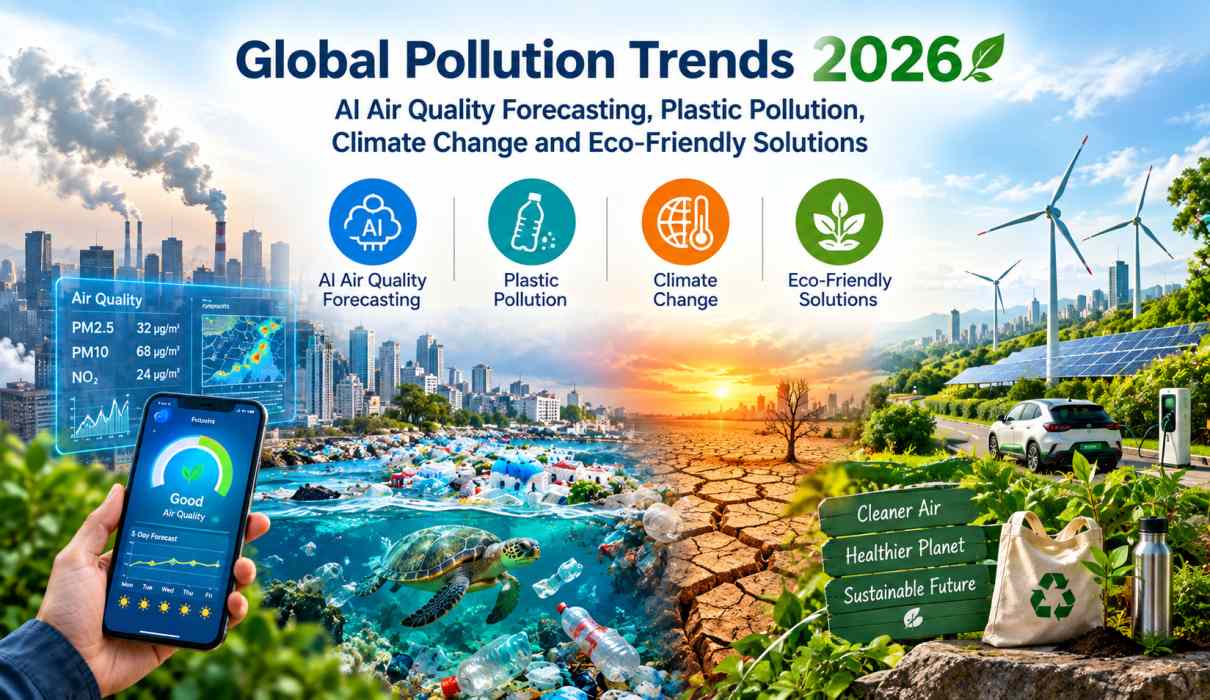
Global Pollution Trends 2026: AI Air Quality Forecasting, Plastic Pollution, Climate Change and Eco-Friendly Solutions
Pollution remains one of the most important environmental challenges facing the world in 2026. Air pollution, plastic waste, water contamination, industrial emissions, chemical pollution, and climate-related environmental changes are increasingly connected. At the same time, new technologies are creating better ways to monitor pollution, predict environmental risks, reduce emissions, and develop sustainable solutions.
One of the most significant developments is the growing use of artificial intelligence for air quality forecasting and environmental monitoring. AI can process large quantities of information from sensors, satellites, weather systems, traffic networks, and environmental databases to help identify pollution patterns and forecast potential pollution events.
Plastic pollution is also receiving increasing attention, particularly because plastic waste can break down into microplastics that move through water, soil, ecosystems, and the atmosphere. The World Meteorological Organization’s 2026 Air Quality and Climate Bulletin highlights the need for better monitoring of airborne microplastics and other pollutants.
Meanwhile, climate change continues to interact with pollution in complex ways. Heatwaves, wildfires, changing rainfall patterns, and atmospheric conditions can influence air quality and the movement of pollutants.
The future of pollution management will therefore require a combination of AI technology, better monitoring, cleaner energy, circular economies, sustainable transportation, responsible consumption, and stronger environmental management.
Understanding Global Pollution in 2026
Pollution occurs when harmful substances or forms of energy enter the environment at levels that can damage human health, ecosystems, or natural resources.
The major categories include:
- Air pollution
- Water pollution
- Soil pollution
- Plastic pollution
- Chemical pollution
- Noise pollution
- Light pollution
- Industrial pollution
- Agricultural pollution
- Electronic waste
Air pollution remains a particularly important concern because pollutants such as particulate matter, nitrogen dioxide, and ground-level ozone can affect human health. The World Health Organization’s 2026 air-quality database continues to track annual concentrations of PM2.5, PM10, and nitrogen dioxide across locations worldwide.
Pollution also does not remain within political or geographic boundaries. Airborne particles can travel across cities, regions, countries, and oceans. Plastic waste can move through rivers into marine ecosystems, while pollutants released into the atmosphere can influence climate and environmental conditions far from their original sources.
AI Air Quality Forecasting Is Transforming Pollution Monitoring
Artificial intelligence is becoming an important tool in environmental science.
Traditional air-quality monitoring depends on physical monitoring stations that collect measurements of pollutants. These stations remain essential, but they can be expensive and may not provide complete coverage of every location.
AI can complement traditional monitoring by analyzing information from multiple sources, including:
- Air-quality sensors
- Satellite observations
- Weather data
- Traffic information
- Industrial activity
- Historical pollution records
- Atmospheric models
- Wildfire information
Machine-learning systems can identify relationships between these variables and pollution levels. This can help generate more detailed forecasts for specific areas.
The World Meteorological Organization reported in 2026 that AI is increasingly influencing atmospheric science, including measurements, data analysis, and modelling. Air-quality forecasting can provide advance warning of pollution events and potentially give authorities time to take measures such as managing traffic or industrial activity.
This represents an important shift from simply measuring pollution after it happens toward predicting potential pollution events before they occur.
Why Air Quality Forecasting Matters
Accurate air-quality forecasting can help individuals, businesses, schools, hospitals, and public authorities make better decisions.
For example, if a forecasting system identifies a high-pollution period, people may choose to reduce outdoor exposure or modify planned activities. Cities can use forecasts to improve traffic management or communicate public-health information.
The WHO emphasizes that continuous, high-quality air-quality monitoring is essential for detecting pollutants, understanding health impacts, informing the public, and supporting pollution-reduction policies.
Modern air-quality systems are therefore moving toward a combination of monitoring, forecasting, public communication, and preventive action.
The Growing Importance of PM2.5 and Ground-Level Ozone
Fine particulate matter, particularly PM2.5, remains a major air-pollution concern.
PM2.5 consists of particles small enough to penetrate deep into the respiratory system. Sources can include transportation, industrial activity, residential combustion, agriculture, dust, and wildfires.
Ground-level ozone is another important pollutant. It is not emitted directly in the same way as many primary pollutants; instead, it can form through chemical reactions involving precursor pollutants under suitable atmospheric conditions.
The 2026 WMO Air Quality and Climate Bulletin emphasizes the need for improved observations of fine particulate matter and ground-level ozone, alongside pollutants such as black carbon and airborne microplastics.
Better monitoring can improve understanding of pollution sources and support more targeted environmental policies.
Plastic Pollution Remains a Global Challenge
Plastic has become an essential material in modern society because it is lightweight, durable, versatile, and relatively inexpensive. However, poor waste management and high levels of plastic production and consumption have created significant environmental challenges.
The United Nations Environment Programme warns that plastic waste could nearly triple by 2060 under a business-as-usual scenario. UNEP’s approach emphasizes system-wide changes involving regulation, innovation, financing, behavior change, and a transition toward a circular plastics economy.
Plastic pollution can affect rivers, oceans, beaches, agricultural environments, wildlife, and urban areas.
The problem is not limited to visible plastic bottles, bags, packaging, and discarded products. Larger plastic items can gradually fragment into smaller particles.
Microplastics Are an Emerging Environmental Concern
Microplastics are tiny plastic particles that can originate from the breakdown of larger plastic materials or from products and processes that release small plastic particles.
They have been detected in marine environments, freshwater, soils, cities, remote areas, and the atmosphere.
The 2026 WMO Air Quality and Climate Bulletin highlights atmospheric microplastics as an area where better monitoring is needed. It notes that microplastics can originate from plastic degradation and can move through the environment, while substantial uncertainty remains because long-term monitoring is insufficient.
This makes microplastic pollution an important research and environmental-management topic for the coming years.
Better measurement techniques will be necessary to understand where these particles originate, how they travel, where they accumulate, and what environmental impacts they may have.
Climate Change and Pollution Are Closely Connected
Climate change and pollution are different environmental problems, but they interact in several ways.
Climate change can influence pollution through temperature, rainfall, wildfire activity, atmospheric circulation, and other environmental conditions. At the same time, certain pollutants can affect the climate system.
The WMO describes air quality and climate change as strongly interconnected despite operating on different timescales. Air pollution can change rapidly over days or weeks, while climate change develops over much longer periods.
Wildfires provide a clear example of this relationship. Hotter and drier conditions in some regions can contribute to conditions favorable for fires, while wildfire smoke can produce substantial amounts of particulate pollution.
Black carbon provides another connection. When soot settles on snow and ice, it can reduce reflectivity and contribute to faster melting.
Understanding these connections is important because pollution and climate policies can sometimes influence each other.
Climate Conditions Can Affect Air Quality
Weather and climate conditions play a major role in determining how pollutants behave.
Temperature, wind, humidity, precipitation, and atmospheric stability can influence whether pollutants disperse or remain concentrated near the ground.
Heatwaves can contribute to conditions that increase ozone formation in some locations. Wildfires can release large amounts of particulate matter and other pollutants. Changes in rainfall can also influence how pollutants move through soil and water systems.
The WMO’s 2026 climate outlook indicates that global temperatures are expected to remain at historically high levels in the coming years, with 2026–2030 annual global mean temperatures projected to remain substantially above the 1850–1900 average.
These developments make integrated climate and pollution monitoring increasingly important.
Eco-Friendly Transportation Solutions
Transportation is an important area for reducing pollution.
Electric vehicles, public transportation, cycling, walking, rail travel, and cleaner fuels can help reduce certain forms of transportation-related pollution.
However, sustainable mobility requires more than replacing conventional vehicles with electric vehicles. Cities also need efficient public transportation, walkable neighborhoods, safe cycling infrastructure, intelligent traffic management, and urban planning that reduces unnecessary travel.
AI can contribute by optimizing traffic signals, predicting congestion, planning public transportation routes, and supporting intelligent mobility systems.
The result can be a more integrated approach to urban air-quality management.
Renewable Energy and Cleaner Industrial Production
Energy production is another major area of environmental transformation.
Renewable energy sources such as solar and wind can help reduce dependence on fossil fuels when appropriately integrated into energy systems. Energy efficiency, storage technologies, smart grids, and cleaner industrial processes can further contribute to emission reductions.
Industries are also exploring technologies that reduce waste, improve resource efficiency, recycle materials, and monitor emissions more accurately.
Digital monitoring can help factories identify inefficient processes and potential pollution sources. AI can analyze industrial data to identify patterns that may indicate excessive energy consumption or abnormal emissions.
Circular Economy and Waste Reduction
One of the most important long-term approaches to pollution reduction is moving from a linear economy toward a circular economy.
The traditional linear model can be summarized as:
Take → Make → Use → Dispose
A circular economy aims to keep materials in use for longer through:
Reduce → Reuse → Repair → Recycle → Recover
This approach can reduce demand for virgin resources and lower the amount of waste entering landfills, rivers, and oceans.
For plastics, circular systems can include reusable packaging, improved collection systems, product redesign, recycling infrastructure, and alternative materials where appropriate.
Businesses can also reduce waste by designing products for durability, repairability, and material recovery.
Smart Cities and Environmental Monitoring
Smart-city technology is becoming increasingly relevant to pollution management.
Cities can combine information from air-quality sensors, traffic systems, weather stations, satellites, public transportation networks, and waste-management systems.
AI can then help analyze these datasets to identify environmental patterns.
Potential applications include:
- Real-time air-quality monitoring
- Pollution hotspot detection
- Smart waste collection
- Traffic optimization
- Emission monitoring
- Noise monitoring
- Water-quality monitoring
- Urban heat analysis
- Environmental risk alerts
The objective is not simply to collect more data. The real value comes from converting environmental information into practical decisions.
The Role of Better Air Quality Indexes
Air Quality Indexes, or AQIs, are widely used to communicate pollution conditions to the public.
However, different countries and systems may calculate AQIs differently. Some focus on the pollutant that exceeds a relevant threshold most significantly, while health-based approaches can consider risks from multiple pollutants.
A WHO report published in January 2026 discusses best practices for developing, validating, and communicating health-based air-quality indexes.
Clear and understandable air-quality communication is important because environmental data only becomes useful when people can interpret it correctly.
Individual Actions Can Support Pollution Reduction
Large-scale environmental improvements require government, industry, scientific, and community action, but individual choices can also contribute.
People can reduce pollution by:
- Using public transportation where practical
- Walking or cycling for suitable journeys
- Reducing unnecessary single-use plastics
- Reusing containers and bags
- Separating recyclable materials
- Avoiding unnecessary waste
- Choosing durable products
- Conserving electricity
- Supporting responsible businesses
- Disposing of electronic waste correctly
- Avoiding littering
- Participating in local environmental initiatives
Individual actions are most effective when supported by appropriate infrastructure and broader systems that make sustainable choices accessible.
The Future of Pollution Management
Pollution management is moving from reactive approaches toward increasingly predictive and integrated systems.
In the future, AI could help authorities identify pollution risks before they become severe. Satellites and low-cost sensors could expand environmental monitoring. Digital platforms could provide real-time information to communities, while smart-city technologies could help manage transportation, waste, energy, and water systems.
At the same time, environmental policy will need to address the underlying causes of pollution, including inefficient resource use, fossil-fuel dependence, poor waste management, and unsustainable production and consumption patterns.
Technology alone cannot solve pollution. It needs reliable data, scientific research, effective infrastructure, responsible business practices, public participation, and appropriate environmental governance.
Conclusion
Global pollution trends in 2026 demonstrate that environmental challenges are becoming increasingly interconnected. Air pollution, plastic waste, microplastics, climate change, industrial emissions, and waste management cannot always be addressed separately.
AI-powered air-quality forecasting is creating new opportunities to monitor pollution and provide earlier warnings. Advanced sensors and satellite systems are improving environmental observations, while better data can support more informed decisions.
Plastic pollution remains a major challenge, particularly as plastic waste breaks down and contributes to microplastic contamination across ecosystems. Climate change adds another layer of complexity because heat, wildfires, changing weather patterns, and atmospheric conditions can influence pollution.
At the same time, eco-friendly solutions are expanding. Renewable energy, electric mobility, public transportation, circular-economy models, sustainable manufacturing, smart-city systems, and improved waste management can all contribute to reducing environmental pressures.
The future of pollution control will ultimately depend on combining technology with practical environmental action. AI can help us predict problems, sensors can help us measure them, and sustainable technologies can help reduce them. But long-term progress requires coordinated efforts to create cleaner air, healthier ecosystems, more efficient resource use, and a more sustainable relationship between society and the environment.