

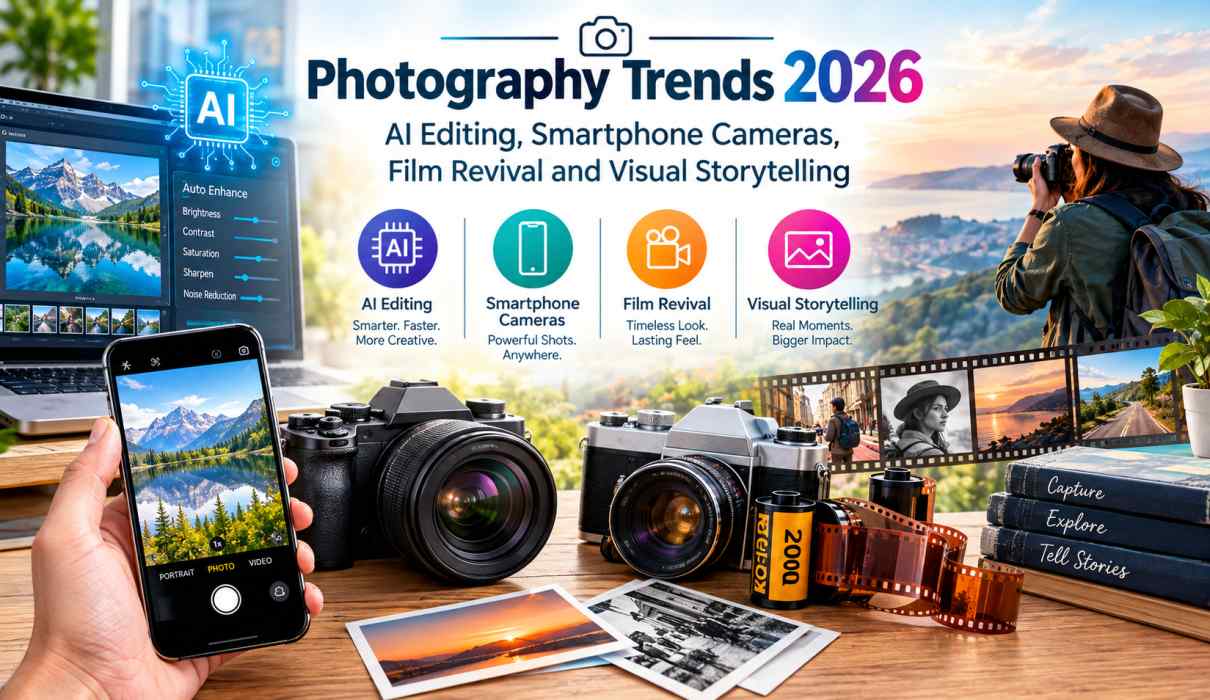
Photography Trends 2026: AI Editing, Smartphone Cameras, Film Revival and Visual Storytelling
Photography continues to evolve as technology, culture and creative habits change. In 2026, photography is no longer defined only by professional cameras and traditional editing software. Artificial intelligence, smartphone cameras, computational photography, film photography and authentic visual storytelling are all influencing how people capture, edit and share images.
The photography trends of 2026 reflect an interesting combination of innovation and nostalgia. On one side, AI-powered editing tools are making advanced image adjustments faster and more accessible. Smartphone cameras are becoming increasingly sophisticated, allowing people to capture high-quality images without carrying traditional camera equipment. On the other side, film photography and compact cameras are attracting renewed attention among creators who value texture, imperfections and a more deliberate photographic process.
At the same time, audiences are becoming more interested in meaningful visual stories rather than technically perfect images alone. Photographers are using images to communicate experiences, emotions, culture, travel, fashion, business and everyday life.
This article explores the biggest photography trends in 2026, including AI editing, smartphone photography, computational imaging, film revival, authentic storytelling, social media photography and the future of creative image-making.
The Changing Photography Landscape in 2026
Photography has always evolved alongside technology. From film cameras to digital cameras and then smartphones, every major technological development has changed how people create images.
The current transformation is particularly significant because several technologies are developing simultaneously.
Photographers now have access to:
- AI-powered photo editing
- Advanced smartphone cameras
- Computational photography
- High-resolution mirrorless cameras
- Compact digital cameras
- Film cameras
- Instant cameras
- Cloud-based editing
- Automated image organization
- Social media publishing tools
- Generative AI features
These technologies are not necessarily replacing one another. Instead, photographers are combining different tools depending on their creative goals.
1. AI-Powered Photo Editing Becomes Mainstream
Artificial intelligence is one of the most influential photography trends in 2026.
AI-powered editing can automate tasks that previously required significant manual effort. Modern editing systems can assist with subject selection, background adjustments, noise reduction, sharpening, lighting corrections and image enhancement.
AI can also help photographers organize large collections of images by identifying subjects, scenes or visual characteristics.
For professionals, these tools can reduce repetitive editing work. For beginners, AI can make sophisticated adjustments more accessible.
However, AI editing also raises important creative questions. When does editing become image creation? How much manipulation is appropriate for documentary or journalistic photography? How should AI-generated elements be disclosed?
These questions are becoming increasingly relevant as the boundary between photography and digital image creation becomes less clear.
2. Generative AI and Creative Photography
Generative AI is expanding the possibilities of image creation and manipulation.
Photographers and designers can use AI-assisted tools to experiment with concepts, backgrounds, compositions and creative treatments. Some workflows combine an original photograph with digitally generated elements.
This can be useful for commercial campaigns, conceptual photography, advertising and creative projects.
However, authenticity remains important. A documentary photograph and an AI-generated image serve different purposes. For professional and editorial work, photographers need to consider transparency and ethical standards when using AI.
The future of photography will therefore involve not only better technology but also clearer distinctions between photographs, edited photographs and AI-generated images.
3. Smartphone Photography Continues to Grow
Smartphone photography remains one of the most accessible forms of photography.
Modern smartphones combine multiple lenses, advanced sensors and computational processing in compact devices. They can automatically improve exposure, dynamic range, focus and low-light performance.
For everyday photographers, this means high-quality photography is available almost everywhere.
Smartphones are particularly influential in:
- Travel photography
- Food photography
- Street photography
- Social media content
- Portrait photography
- Short-form video
- Product photography
- Everyday documentation
The convenience of smartphones also changes photographic behavior. People can capture spontaneous moments immediately rather than waiting to use a dedicated camera.
4. Computational Photography Becomes More Important
Smartphone photography is closely connected to computational photography.
Instead of relying entirely on the physical camera and lens, computational photography combines multiple exposures, software processing and machine learning to produce an image.
Features such as night photography, HDR, portrait effects and advanced zoom can depend heavily on computational processing.
This approach is changing the definition of camera quality. A small smartphone sensor can produce impressive results because software plays an increasingly important role in the final image.
In 2026, photographers are therefore paying attention not only to megapixels and lenses but also to the computational systems behind the camera.
5. The Revival of Film Photography
One of the most interesting photography trends is the continued interest in film.
At a time when digital technology is becoming increasingly powerful, film photography offers something different: a slower, more physical and often less predictable creative process.
Film photographers may appreciate:
- Natural grain
- Distinctive color rendering
- Organic imperfections
- Limited exposures
- Physical negatives
- Slower shooting
- A tangible photographic process
Film also creates a different relationship between photographer and subject. With a limited number of exposures, photographers may think more carefully before pressing the shutter.
The renewed interest in film demonstrates that new technology does not necessarily eliminate older technologies. Instead, different photographic approaches can coexist.
6. Retro and Compact Cameras Attract Attention
Compact and retro-style cameras are also becoming part of the modern photography conversation.
Many photographers appreciate smaller cameras because they are easier to carry and less intimidating than large professional equipment.
Compact cameras can encourage spontaneous photography, particularly for travel and street photography.
Retro-inspired designs can also appeal to photographers who enjoy physical controls and a connection with traditional camera design.
This trend reflects a broader interest in photography as an experience rather than simply a technical process.
7. Authenticity Becomes a Creative Advantage
The abundance of digitally enhanced and AI-generated imagery is increasing interest in authenticity.
Audiences are exposed to enormous quantities of polished images every day. As a result, natural-looking photographs and genuine moments can feel distinctive.
Photographers are increasingly exploring:
- Candid portraits
- Real-life moments
- Documentary-style images
- Natural lighting
- Imperfect compositions
- Behind-the-scenes photography
- Personal visual diaries
Authenticity does not necessarily mean avoiding editing. Instead, it can mean preserving the character and truth of the original moment.
This is particularly important for brands and creators who want to build trust with audiences.
8. Visual Storytelling Takes Centre Stage
Photography is increasingly about storytelling rather than individual attractive images.
A powerful photograph can communicate a person’s personality, the atmosphere of a location or the emotion of an event.
Visual storytelling can be used in:
- Travel photography
- Wedding photography
- Documentary photography
- Brand campaigns
- Fashion photography
- Food photography
- Editorial projects
- Social media content
Instead of simply asking whether an image looks beautiful, photographers can ask what the image communicates.
A strong visual story can use a series of photographs to show context, details, people and emotions.
9. Documentary and Lifestyle Photography
Lifestyle photography continues to move toward natural and relatable scenes.
Rather than relying exclusively on heavily posed compositions, photographers may capture people interacting naturally with their environments.
This approach is particularly popular in branding, family photography, travel and social media.
Documentary-style photography can create a stronger sense of realism because it focuses on moments as they happen.
For brands, this can also support more authentic communication by showing products within real-world situations.
10. Mobile Content and Social Media Photography
Social platforms continue to influence photographic styles.
Vertical images, short videos, carousels and behind-the-scenes content have changed how photographers think about composition.
Photographers increasingly consider where an image will be displayed before creating it.
A photograph may need to work as:
- A website banner
- An Instagram post
- A vertical social story
- A digital advertisement
- A printed photograph
- A thumbnail
- A video cover
This means adaptability is becoming an important photographic skill.
11. Photography and Short-Form Video Converge
The distinction between photography and video continues to become less rigid.
Many modern cameras and smartphones can capture high-quality still images and video. Content creators often use both formats during the same shoot.
A photographer may capture portraits while simultaneously recording short clips for social media.
This convergence is particularly important for businesses, influencers, travel creators and brands that need multiple forms of visual content.
Understanding movement, sound and sequencing can therefore complement traditional photographic skills.
12. Drone and Aerial Photography
Aerial photography continues to provide a unique perspective on landscapes, architecture, tourism and events.
Drones allow photographers to capture locations from viewpoints that would otherwise be difficult to reach.
Aerial imagery is widely useful for:
- Real estate
- Travel
- Landscape photography
- Construction
- Events
- Tourism marketing
- Environmental documentation
As drone technology becomes more accessible, photographers must also pay attention to local regulations, safety requirements and privacy considerations.
13. Sustainable Photography Practices
Sustainability is becoming relevant to photography as well.
Photographers are considering equipment longevity, responsible purchasing and reducing unnecessary consumption.
Instead of constantly replacing cameras and lenses, some photographers are choosing to maintain equipment for longer periods.
Digital workflows can also reduce the need for physical proofs and unnecessary printing, although professional printing remains important for fine-art and commercial work.
For photography businesses, sustainable practices can become part of broader environmental commitments.
14. AI-Assisted Photo Organization
Photographers can accumulate thousands of images over time. Finding specific photographs can therefore become a major challenge.
AI-assisted organization tools can help identify people, locations, subjects and visual characteristics.
For professionals managing large libraries, better organization can save time.
For example, a photographer may be able to search a collection for particular subjects or locations rather than manually reviewing every folder.
This makes image management an increasingly important part of modern photography workflows.
15. Photography for E-Commerce and Digital Business
Online businesses continue to depend heavily on photography.
Product images can influence how customers understand products and make purchasing decisions.
In 2026, businesses are using combinations of traditional photography, AI-assisted editing and creative digital production to create product visuals.
However, accuracy remains essential. Product photography should represent the actual product honestly, particularly for colors, sizes, materials and important details.
High-quality photography can strengthen online presentation while maintaining consumer trust.
16. Personalized and Niche Photography
Photography is becoming increasingly specialized.
Instead of trying to appeal to everyone, photographers can build expertise around specific subjects such as:
- Food
- Architecture
- Weddings
- Wildlife
- Sports
- Fashion
- Travel
- Real estate
- Products
- Automotive photography
- Portraits
- Events
Specialization can help photographers develop recognizable styles and attract audiences interested in particular visual subjects.
Social media and online portfolios make it easier for photographers to showcase niche work to relevant audiences.
The Future of Photography Skills
Technology is changing photography, but fundamental skills remain valuable.
Understanding light, composition, perspective, color, timing and storytelling continues to matter.
Photographers also increasingly benefit from digital skills such as:
- AI-assisted editing
- Color management
- Video production
- Social media publishing
- Digital asset management
- Online portfolio development
- Content strategy
The strongest photographers of the future may be those who combine traditional visual knowledge with modern technology.
Challenges Facing Photography in 2026
The rapid development of AI also creates challenges.
Image authenticity, copyright, consent, misinformation and disclosure are becoming increasingly important topics.
Photographers need to understand how their tools work and how AI-generated elements may affect the meaning of their images.
There is also growing competition because high-quality smartphone cameras and accessible editing software allow more people to produce professional-looking content.
This makes creativity, originality, storytelling and personal style increasingly important.
What Photography May Look Like in the Future
The future of photography is unlikely to be controlled by a single technology.
Instead, photographers will have more choices than ever.
A creator might use a smartphone for spontaneous street photography, a mirrorless camera for professional portraits, film for personal projects and AI tools for organizing or editing a large image library.
This flexibility is one of the most exciting aspects of modern photography.
Technology can make photography faster and more accessible, while traditional approaches can provide a sense of craft and authenticity.
Conclusion
The photography trends of 2026 demonstrate that photography is evolving rather than disappearing into a purely digital future.
AI-powered editing is making advanced image processing more accessible. Smartphone cameras and computational photography are allowing people to capture impressive images wherever they go. At the same time, film photography, compact cameras and authentic visual styles are experiencing renewed interest.
Visual storytelling is also becoming increasingly important. Audiences want images that communicate emotion, personality, experience and meaning rather than simply looking technically perfect.
The future of photography will therefore combine AI innovation with human creativity, advanced smartphone imaging with traditional cameras, digital convenience with film’s tactile experience, and technological development with authentic storytelling.
For photographers, creators and businesses, 2026 offers an expanding creative landscape. The most valuable approach is not necessarily choosing between old and new technologies, but understanding how different tools can work together to create memorable, meaningful and visually engaging photographs.