

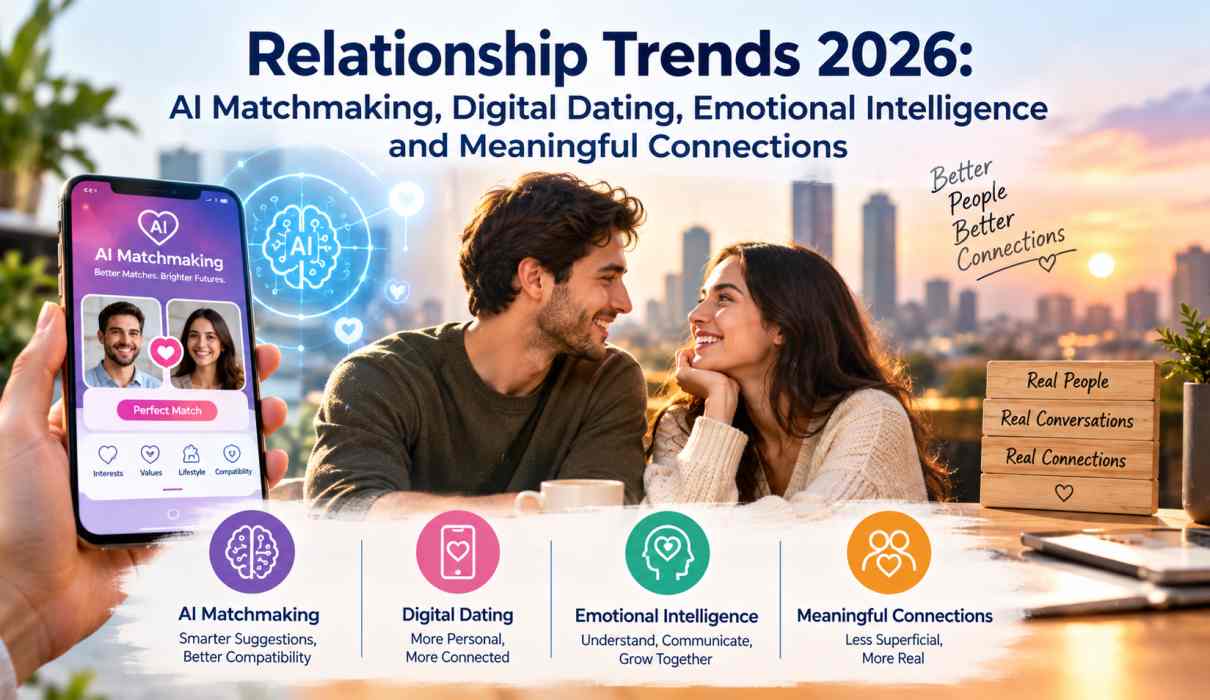
Relationship Trends 2026: AI Matchmaking, Digital Dating, Emotional Intelligence and Meaningful Connections
Relationships are changing rapidly in 2026 as technology, social habits, communication styles and expectations around emotional wellbeing continue to evolve. From AI matchmaking and digital dating to stronger interest in emotional intelligence and meaningful connections, modern relationships are becoming more personalized, flexible and technology-driven.
Dating apps and social platforms remain important ways for people to meet, but technology is no longer simply a place to find a potential partner. Artificial intelligence can now influence recommendations, conversations, content and decision-making. At the same time, many people are placing greater value on authenticity, trust, communication, emotional availability and healthy boundaries.
AI is also becoming part of everyday life more broadly. A 2026 Pew Research Center survey found that about half of U.S. adults reported using AI chatbots, while younger adults were considerably more likely than older adults to use them for emotional support or advice. These developments raise an important question: how can technology make dating easier without replacing the human connection that makes relationships meaningful?
This guide explores the biggest relationship trends in 2026, including AI matchmaking, digital dating, emotional intelligence, communication, personal boundaries and the growing demand for genuine relationships.
1. AI Matchmaking Is Transforming Modern Dating
One of the most noticeable relationship trends in 2026 is the growing role of artificial intelligence in matchmaking. Dating platforms can use algorithms to analyze information such as interests, preferences, location, communication patterns and stated relationship goals to provide more personalized recommendations.
Traditional online dating often requires users to browse large numbers of profiles. AI-assisted systems can potentially make this process more targeted by identifying characteristics that may be relevant to a person’s preferences.
AI can also help with practical aspects of dating, such as:
- Improving profile recommendations
- Suggesting conversation starters
- Organizing dating preferences
- Helping users identify common interests
- Personalizing search results
- Providing profile-writing assistance
- Supporting communication and scheduling
However, AI matchmaking does not eliminate the need for human judgment. Compatibility involves personality, values, chemistry, communication and life circumstances that cannot always be accurately predicted by an algorithm.
The most useful role for AI may therefore be as a dating assistant rather than a replacement for human decision-making.
2. Digital Dating Is Becoming More Personalized
Digital dating continues to evolve beyond the traditional swipe-based experience. In 2026, users increasingly expect dating platforms to provide more relevant profiles, better communication tools and clearer ways to express relationship intentions.
People may want different types of relationships, from long-term partnerships and marriage to companionship, casual dating or simply meeting new people. Clearer profiles and preference settings can help reduce misunderstandings.
Personalization is also becoming important in how people communicate online. Instead of relying entirely on generic profile information, users can showcase hobbies, lifestyles, interests, values and personality.
Short videos, voice messages, social content and interactive profiles can give potential matches more context before an in-person meeting.
This creates a more detailed digital introduction, but it also makes authenticity increasingly important. Highly edited profiles may attract attention, but honest representation can be more valuable when the goal is to build a lasting relationship.
3. Emotional Intelligence Is Becoming a Relationship Priority
Technology may help people meet, but emotional intelligence remains a fundamentally human relationship skill.
Emotional intelligence involves recognizing emotions, understanding another person’s perspective, communicating feelings effectively and responding thoughtfully during difficult situations.
In modern relationships, emotional intelligence can help partners:
- Express feelings clearly
- Listen without immediately judging
- Recognize emotional needs
- Handle disagreements constructively
- Respect different perspectives
- Apologize and repair misunderstandings
- Build emotional trust
Dating in 2026 is therefore not only about finding someone with similar interests. Many people are also interested in finding someone who can communicate openly and handle emotional situations maturely.
A strong relationship requires more than attraction. Emotional awareness can help partners understand each other when circumstances become complicated.
4. Meaningful Connections Are Becoming More Important
Digital platforms provide countless opportunities to meet people, but more options do not automatically create deeper relationships.
One of the important modern relationship trends in 2026 is a renewed interest in meaningful connections. People may become more selective about where they invest their time and emotional energy.
Instead of maintaining a large number of superficial conversations, some daters may prefer fewer conversations that develop into genuine connections.
Meaningful relationships often involve:
- Shared values
- Mutual respect
- Emotional availability
- Honest communication
- Reliability
- Shared experiences
- Personal growth
- Long-term compatibility
Technology can introduce two people, but meaningful connection develops through conversations and experiences that take place beyond the screen.
5. Digital Boundaries Are Becoming Essential
As smartphones, messaging apps and social platforms become deeply integrated into relationships, digital boundaries are becoming increasingly important.
Partners may have different expectations about texting frequency, social media activity, online privacy and availability.
For example, one person may enjoy communicating throughout the day while another may prefer fewer but more meaningful conversations. Neither approach is automatically correct. The important factor is communication and mutual understanding.
Healthy digital boundaries may include:
- Agreeing on reasonable communication expectations
- Respecting private conversations
- Avoiding unnecessary phone monitoring
- Discussing social media boundaries
- Allowing personal offline time
- Respecting work and sleep schedules
- Avoiding pressure to respond immediately
A healthy relationship does not require constant digital availability.
6. AI Is Entering Personal and Emotional Spaces
AI is becoming more common in people’s everyday lives, including areas involving emotions and personal advice. Pew Research Center reported in 2026 that 10% of U.S. adults who use AI chatbots said they use them for emotional support or advice, while 4% reported using them for companionship. Among adults ages 18 to 29, the figures were higher.
This development is relevant to relationships because AI can become part of the way people reflect on emotions, prepare for conversations or explore relationship questions.
For example, someone might use an AI tool to organize their thoughts before discussing a disagreement with a partner. Another person might ask for help writing a difficult message.
These uses can be practical, but technology should not replace direct communication between people.
A relationship is built through shared experiences, vulnerability, trust and mutual understanding. AI can provide information or suggestions, but it does not experience the relationship itself.
7. Authenticity Is Becoming a Major Dating Advantage
With AI-generated text, edited photographs and increasingly sophisticated digital tools, authenticity is becoming more valuable.
A dating profile can be professionally polished, but potential partners eventually discover how closely the online presentation matches real life.
Authenticity means presenting yourself honestly rather than creating an idealized identity simply to attract attention.
This can include:
- Using recent and realistic photographs
- Describing genuine interests
- Being honest about relationship goals
- Avoiding misleading information
- Communicating naturally
- Showing personality rather than only achievements
Authenticity can make online dating more comfortable because both people enter the relationship with more realistic expectations.
8. Communication Quality Matters More Than Message Quantity
Another important relationship trend is the growing focus on quality communication.
Sending hundreds of messages does not necessarily create emotional closeness. A meaningful conversation may be more valuable than constant small talk.
Good communication involves asking thoughtful questions, listening carefully and showing interest in another person’s experiences.
Instead of repeatedly asking questions such as “What are you doing?”, people can explore topics such as goals, travel, family traditions, hobbies, career ambitions, personal values and future plans.
However, deeper communication should develop naturally. Emotional openness should not become an obligation during the earliest stages of dating.
9. Slow Dating and Intentional Relationships
The speed of digital dating can sometimes create pressure to move quickly from one conversation to another. In response, slow dating and intentional dating are becoming useful concepts for people who want more thoughtful relationship experiences.
Slow dating does not necessarily mean avoiding dating apps. Instead, it can mean being more selective about matches and spending more time getting to know someone before making major assumptions.
Intentional dating can involve asking:
- What type of relationship am I looking for?
- What values matter most to me?
- What communication style works for me?
- What boundaries are important?
- Am I genuinely interested in this person?
This approach can help reduce the feeling that dating is simply a search for the next available match.
10. In-Person Experiences Still Matter
Despite the growth of digital dating, physical experiences remain an essential part of relationships.
A relationship can begin through an app, social network or online community, but partners eventually need opportunities to interact in real-world environments.
Coffee dates, walks, cultural events, restaurants, travel, hobbies and shared activities can reveal aspects of compatibility that are difficult to understand through messaging alone.
In-person experiences also provide opportunities to observe communication style, body language, humor, attentiveness and everyday behavior.
The future of dating is therefore unlikely to be purely digital. Instead, digital discovery and real-world connection can work together.
11. Relationship Wellness Is Growing
The concept of relationship wellness is becoming broader in 2026. A healthy relationship is increasingly viewed as something that supports the individual wellbeing of both partners.
Relationship wellness can involve:
- Mutual emotional support
- Respect for individuality
- Healthy conflict resolution
- Shared responsibilities
- Personal space
- Support for career goals
- Time spent together
- Healthy social connections outside the relationship
A strong partnership does not require two people to have identical personalities or interests. Healthy relationships can allow partners to maintain individual identities while building a shared life.
12. Long-Distance Relationships Are Becoming More Connected
Technology continues to make long-distance relationships easier to maintain.
Video calls, instant messaging, shared digital activities and online entertainment allow couples to stay connected across cities and countries.
However, technology cannot completely remove the challenges of physical distance. Successful long-distance relationships still require trust, communication, realistic expectations and plans for spending time together.
Digital tools are most useful when they support emotional connection rather than becoming a substitute for it.
13. Safety and Privacy Remain Critical
As online dating grows, personal safety and privacy remain important considerations.
People should be careful about sharing sensitive personal information with someone they have recently met online. It is also sensible to be cautious about financial requests, suspicious links, identity inconsistencies or pressure to move conversations away from trusted platforms too quickly.
For first meetings, public locations and informing a trusted person about plans can provide additional safety.
Dating technology can create opportunities, but responsible digital behavior remains essential.
14. The Future of Relationships Will Combine Technology and Humanity
The biggest relationship trend of 2026 may not be a particular dating app or AI feature. It may be the combination of technology with a renewed emphasis on human connection.
AI can help people discover potential matches, organize information and support communication. Dating platforms can make meeting people more convenient. Social networks can help individuals connect across geographic boundaries.
But long-term relationships still depend on qualities such as trust, empathy, honesty, patience and respect.
Pew Research Center’s 2026 research also highlights the mixed public response to AI. While AI use is increasing, many people remain cautious about its broader effects, including its potential impact on relationships and meaningful human connection.
This suggests that the future of relationships is unlikely to be about replacing human interaction with artificial intelligence. Instead, the more practical direction is using technology selectively while protecting the human elements of relationships.
How to Build Better Relationships in 2026
Whether someone is dating online or already in a long-term partnership, several principles can help create healthier connections:
Be authentic: Present yourself honestly rather than creating a perfect digital identity.
Communicate clearly: Explain expectations, feelings and boundaries instead of expecting a partner to guess them.
Use technology thoughtfully: AI and dating platforms can provide useful tools, but they should support rather than replace human communication.
Prioritize emotional intelligence: Listen, understand different perspectives and manage disagreements respectfully.
Protect privacy: Avoid sharing sensitive information too quickly with people you have recently met online.
Create real experiences: Spend time together away from screens and build shared memories.
Respect individuality: Healthy relationships allow both partners to maintain personal interests, friendships and goals.
Focus on quality: A smaller number of meaningful connections may be more valuable than constantly searching for new matches.
Conclusion
Relationship Trends 2026 show that modern love is becoming a combination of technology, personalization and human connection. AI matchmaking and digital dating are changing how people discover potential partners, while emotional intelligence, authenticity and meaningful communication remain central to building lasting relationships.
The role of technology will probably continue to expand. AI may become more involved in matchmaking, communication and personal relationship tools. Yet technology cannot completely reproduce the trust, empathy, shared experiences and emotional connection that develop between real people.
The most meaningful relationships in 2026 are therefore likely to balance digital convenience with human authenticity. People can use technology to meet, communicate and discover new possibilities while still making space for face-to-face experiences, emotional openness and genuine connection.
Ultimately, the future of relationships is not simply about smarter dating technology. It is about using technology wisely while preserving the human qualities that make relationships meaningful.