

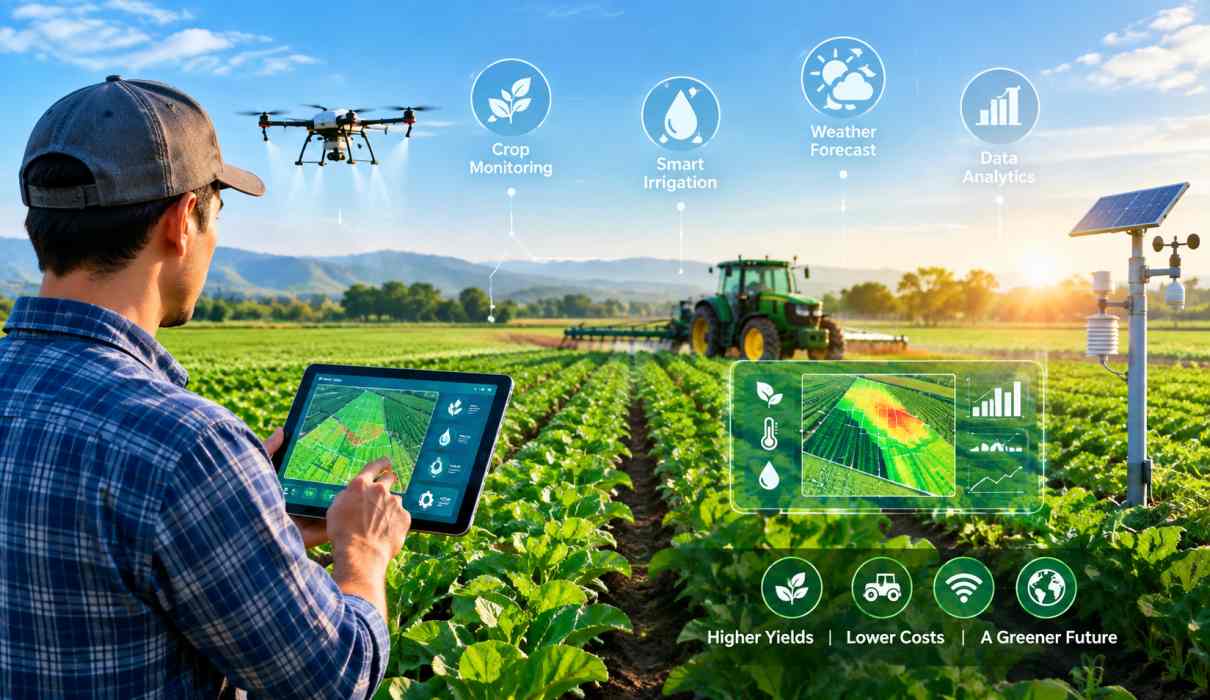
Smart Agriculture: How Technology Is Transforming Modern Farming
Agriculture is changing rapidly as farmers around the world adopt new technologies to improve productivity, reduce costs, manage resources, and respond to changing climate conditions. Traditional farming knowledge remains important, but modern tools such as artificial intelligence, Internet of Things (IoT) devices, drones, satellite imagery, automation, and precision farming are creating new opportunities for more efficient agricultural production.
Smart agriculture refers to the use of digital technologies, data, connected devices, and advanced farming techniques to make better decisions throughout the agricultural process. From monitoring soil conditions to predicting crop diseases and optimizing irrigation, technology is helping farmers use resources more precisely while improving farm management.
For farmers, agricultural businesses, and consumers, the growth of smart farming could play an important role in building a more productive and sustainable food system. This article explores what smart agriculture means, the technologies behind it, its major benefits, challenges, and the future of technology-driven farming.
What Is Smart Agriculture?
Smart agriculture is a modern approach to farming that uses technology and data to improve agricultural operations. It combines traditional farming practices with digital tools that can monitor conditions, analyze information, automate tasks, and support better decision-making.
Unlike conventional farming, where decisions may depend heavily on fixed schedules or general observations, smart farming can use real-time information. For example, soil sensors can measure moisture levels, weather platforms can provide local forecasts, and satellite imagery can help identify areas of crop stress.
The goal is not simply to use more technology. Instead, smart agriculture focuses on using the right information and resources at the right time and in the right place.
This approach can be applied to crop cultivation, livestock management, irrigation, greenhouse farming, farm machinery, supply chains, and post-harvest operations.
Why Is Smart Agriculture Becoming Important?
Agriculture faces several challenges, including changing weather patterns, water shortages, soil degradation, rising input costs, labor constraints, and increasing demand for food.
Farmers need to produce efficiently while managing limited resources. Technology can help address some of these challenges by making agricultural decisions more data-driven.
For example, precision irrigation can help deliver water according to crop and soil requirements instead of applying the same amount across an entire field. Similarly, satellite images and drones can help farmers monitor large areas without physically inspecting every part of a field.
Smart agriculture can therefore support three important objectives:
- Improving farm productivity
- Using natural resources more efficiently
- Making agricultural operations more sustainable
Key Technologies Transforming Modern Farming
Several technologies are driving the development of smart agriculture.
1. Internet of Things (IoT) in Agriculture
The Internet of Things connects physical devices to digital systems so that information can be collected and analyzed.
In farming, IoT sensors can monitor:
- Soil moisture
- Temperature
- Humidity
- Soil conditions
- Water levels
- Weather conditions
- Equipment performance
- Livestock activity
For example, a soil moisture sensor can detect when a field is becoming too dry. The information can then be sent to a mobile application or farm management platform.
This allows farmers to make irrigation decisions based on actual field conditions rather than relying only on fixed watering schedules.
IoT technology can be particularly useful for greenhouse farming, precision irrigation, livestock monitoring, and large-scale agricultural operations.
2. Artificial Intelligence and Machine Learning
Artificial intelligence is becoming an important part of modern agriculture.
AI systems can process large amounts of information from sensors, satellites, weather services, cameras, and farm records. Machine learning models can identify patterns and help predict potential agricultural problems.
AI can support applications such as:
- Crop disease detection
- Yield forecasting
- Weather analysis
- Pest monitoring
- Irrigation recommendations
- Crop planning
- Market and demand analysis
For example, computer vision systems can analyze images of leaves and identify signs that may indicate disease or nutrient deficiencies.
AI does not replace farmers’ knowledge. Instead, it can provide additional information that helps farmers make more informed decisions.
3. Agricultural Drones
Drones are another technology transforming modern farming.
Equipped with cameras and sensors, agricultural drones can capture detailed images of farmland. Farmers can use these images to monitor crop growth, identify stressed areas, inspect irrigation systems, and assess field conditions.
Some agricultural drones can also be used for targeted spraying and other field operations, subject to local regulations and appropriate operating practices.
One major advantage of drones is their ability to cover large areas quickly. Instead of manually inspecting an entire field, farmers can use aerial imagery to identify locations that require closer attention.
4. Satellite Technology and Remote Sensing
Satellite imagery provides farmers with a broader view of agricultural land.
Modern remote-sensing systems can provide information about vegetation, crop development, moisture conditions, and changes across fields.
Satellite data can help farmers:
- Monitor crop health
- Identify areas of stress
- Track crop development
- Analyze field variability
- Plan irrigation
- Support yield estimation
Because satellite imagery can cover large geographic areas, it is particularly useful for large farms and agricultural organizations managing multiple fields.
5. Precision Agriculture
Precision agriculture is one of the most important concepts within smart farming.
The basic idea is to manage different parts of a field according to their specific requirements rather than treating the entire field identically.
A field may contain areas with different soil types, moisture levels, nutrient conditions, or crop performance. Precision farming technologies help identify these differences.
Farmers can then adjust the application of:
- Water
- Fertilizers
- Seeds
- Crop protection products
- Other agricultural inputs
This can improve resource efficiency and potentially reduce unnecessary input use.
6. Smart Irrigation Systems
Water management is becoming increasingly important in agriculture.
Traditional irrigation methods may sometimes result in water being applied according to a fixed schedule rather than actual crop requirements. Smart irrigation systems can use soil sensors, weather data, crop information, and automated controls to improve irrigation decisions.
Depending on the system, farmers can monitor soil moisture remotely and automate irrigation equipment.
Smart irrigation can help reduce water waste while ensuring crops receive adequate moisture. This is especially valuable in regions facing water scarcity or unpredictable rainfall.
7. Farm Automation and Robotics
Automation is gradually changing agricultural labor and farm operations.
Robotic and automated systems can assist with tasks such as:
- Seeding
- Weeding
- Harvesting
- Sorting
- Monitoring
- Greenhouse management
Automated machinery can operate with greater consistency and, in some applications, reduce the amount of manual labor required.
As agricultural labor challenges increase in some regions, automation may become an increasingly important part of modern farm management.
Benefits of Smart Agriculture
Smart agriculture offers several potential benefits for farmers and the broader agricultural sector.
Better Resource Management
One of the biggest advantages is improved use of resources.
Data-driven irrigation, fertilization, and crop management can help farmers apply resources according to actual needs.
This can contribute to more efficient use of water, fertilizer, energy, and other inputs.
Improved Crop Monitoring
Technology allows farmers to monitor crops more frequently.
Sensors, drones, satellite imagery, and mobile applications can provide information about crop conditions without requiring constant physical inspection.
Early identification of crop stress can allow farmers to investigate problems sooner.
Increased Productivity
Smart farming technologies can support better decision-making throughout the growing season.
Accurate information about soil, weather, crop health, and irrigation can help farmers optimize production practices.
The results will vary by crop, location, technology, and farm management, but data-driven farming can create opportunities for improving productivity.
Reduced Operational Costs
Automation and precision farming can potentially reduce unnecessary input use and improve operational efficiency.
For example, targeted irrigation or input application can reduce waste compared with applying resources uniformly when field conditions vary.
Better Climate Resilience
Weather uncertainty can make farming more difficult.
Smart agriculture can help farmers monitor weather forecasts, soil moisture, crop conditions, and other indicators. This information can support decisions related to irrigation, planting, crop protection, and harvesting.
Technology alone cannot eliminate climate-related risks, but it can provide farmers with better information for managing them.
Smart Agriculture in India
India’s agricultural sector is particularly significant because millions of farmers depend on agriculture for livelihoods and food production.
The adoption of smart farming technologies in India is expanding across areas such as precision agriculture, agricultural drones, remote sensing, digital marketplaces, farm management applications, automated irrigation, and weather-based advisory services.
However, technology adoption varies considerably based on farm size, region, crop type, infrastructure, affordability, and digital access.
For small and marginal farmers, affordable and easy-to-use technology is especially important. Mobile-based agricultural services, shared equipment models, farmer cooperatives, and agricultural technology providers can help make advanced tools more accessible.
The future of smart agriculture in India will therefore depend not only on advanced technology but also on accessibility, affordability, local-language support, training, connectivity, and farmer awareness.
Challenges of Smart Agriculture
Although smart agriculture offers significant opportunities, it also has challenges.
High Initial Investment
Advanced sensors, drones, automated machinery, and specialized software can require significant investment.
For smaller farms, the initial cost may be a major barrier.
Digital Skills
Farmers need training to understand and use digital agricultural tools effectively.
Technology that is difficult to operate or interpret may have limited practical value.
Internet and Connectivity
Many smart farming systems depend on reliable connectivity.
Rural areas with limited internet or mobile infrastructure may face difficulties using cloud-based agricultural platforms.
Data Privacy and Ownership
Smart farming generates large quantities of agricultural data.
Questions about who owns farm data, who can access it, and how it is used are becoming increasingly important as digital agriculture expands.
Technology Integration
Different devices and platforms may not always work together smoothly.
Farmers may need integrated systems that combine sensor information, weather data, machinery data, and farm records in one accessible platform.
The Future of Smart Agriculture
The future of agriculture is likely to involve greater integration between farmers, machines, data, and artificial intelligence.
Future smart farms may use connected systems that continuously collect information from fields and provide recommendations through mobile devices or farm management platforms.
AI could become more capable of analyzing crop images, weather patterns, soil data, and historical farm information. Robotics could assist with repetitive agricultural tasks, while autonomous machinery may become more common in some farming systems.
Digital twins and advanced farm simulations could also help farmers model different production scenarios before making decisions.
At the same time, sustainable agriculture will remain an important priority. Technology will increasingly be evaluated not only by how much it can automate but also by how effectively it helps farmers conserve water, protect soil, reduce waste, and adapt to environmental challenges.
How Farmers Can Start With Smart Agriculture
Farmers do not necessarily need to adopt every new technology at once.
A practical approach is to begin with a specific agricultural problem.
For example:
- Identify a major farm challenge.
- Collect basic information about the problem.
- Select an appropriate technology.
- Start with a small pilot area.
- Measure the results.
- Compare costs and benefits.
- Expand the technology if it proves useful.
A farmer dealing with inefficient irrigation could begin with soil moisture sensors. Another farmer struggling with crop monitoring might test drone or satellite imagery.
Starting small can help farmers understand whether a technology provides enough value before making a larger investment.
Conclusion
Smart agriculture is transforming modern farming by bringing together technology, data, automation, and traditional agricultural knowledge. From AI and IoT sensors to drones, satellite imagery, precision farming, and smart irrigation, digital tools are helping farmers understand their fields and manage resources more efficiently.
The goal of smart farming is not to replace farmers. Instead, technology can give farmers better information and more precise tools for making decisions.
As agriculture faces rising demand, resource constraints, labor challenges, and changing environmental conditions, technology-driven farming is likely to become increasingly important. However, successful adoption will depend on affordability, digital skills, reliable infrastructure, data management, and solutions designed around real farming needs.
The future of agriculture will not be defined by technology alone. It will be shaped by how effectively farmers combine experience, scientific knowledge, data, and innovation to create productive and sustainable farming systems.
For farmers and agricultural businesses, the opportunity is to adopt technology strategically—starting with practical problems and choosing solutions that deliver measurable value. With the right approach, smart agriculture can contribute to a more efficient, resilient, and sustainable future for farming.