

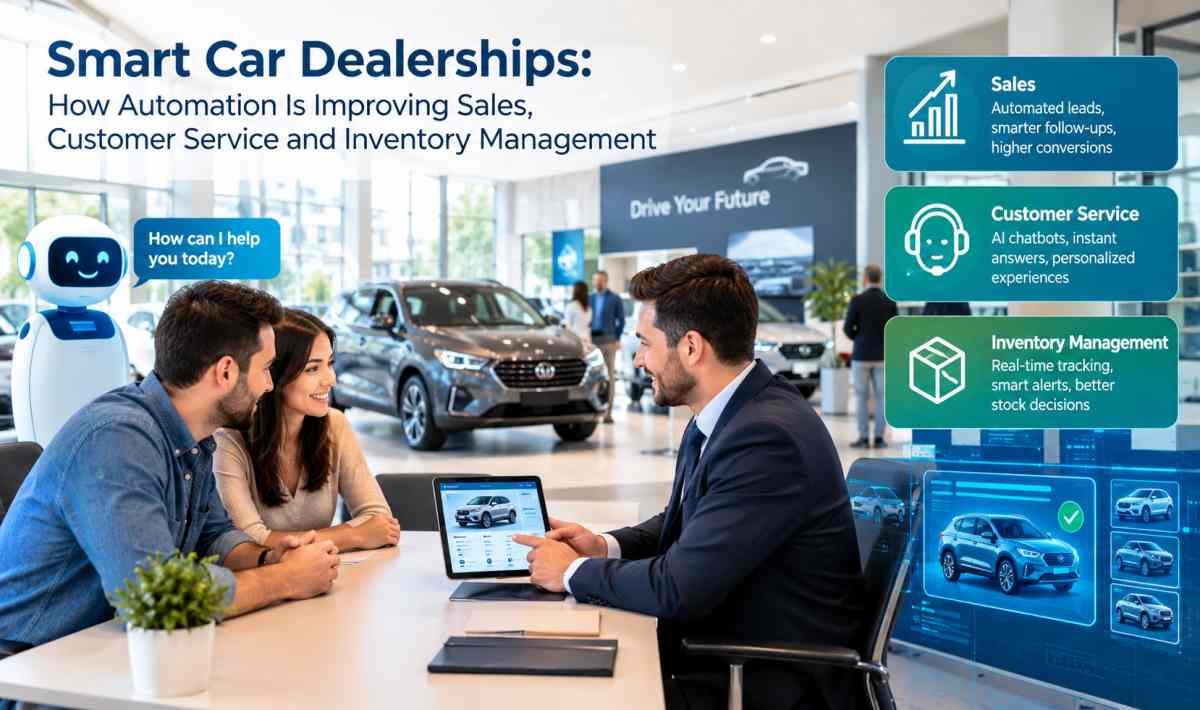
Smart Car Dealerships: How Automation Is Improving Sales, Customer Service and Inventory Management
The automotive industry is changing rapidly as technology transforms how vehicles are marketed, purchased, sold, and maintained. Traditional car dealerships are increasingly adopting digital tools and automation to improve efficiency, attract customers, and remain competitive. From automated lead management and AI-powered chatbots to intelligent inventory systems and digital financing, modern technology is reshaping the entire car-buying experience.
Smart car dealerships are becoming an important part of this transformation. By combining automation, artificial intelligence (AI), customer relationship management (CRM) software, and data analytics, dealerships can simplify daily operations while delivering faster and more personalized customer service.
Today’s customers expect convenient communication, transparent pricing, accurate vehicle information, and flexible purchasing options. Dealerships that rely entirely on manual processes may struggle to meet these expectations. Automation helps businesses respond to inquiries quickly, organize sales opportunities, manage vehicle stock efficiently, and build stronger customer relationships.
Whether operating a small used-car dealership or a large automotive showroom, adopting smart dealership technology can offer significant advantages. In this article, we explore how automation is improving car dealership sales, customer service, inventory management, and long-term business growth.
What Is a Smart Car Dealership?
A smart car dealership is an automotive sales business that uses digital technology, connected software, automation, and data-driven tools to manage its operations more efficiently.
Instead of depending entirely on paperwork, phone calls, spreadsheets, and manual follow-ups, smart dealerships use integrated systems to automate repetitive tasks and provide employees with better information.
These systems may include customer relationship management platforms, digital vehicle catalogs, automated marketing tools, online appointment scheduling, inventory management software, electronic documentation, and AI-powered customer support.
For example, when a customer submits an online inquiry about a particular vehicle, an automated system can record the customer’s details, notify the sales team, send an acknowledgment, and schedule a follow-up reminder.
Similarly, when a vehicle is sold, inventory software can update its availability across connected sales channels, reducing the risk of advertising a vehicle that is no longer available.
The primary goal of a smart car dealership is not to eliminate human interaction. Instead, automation allows employees to spend less time on repetitive administrative work and more time helping customers make informed purchasing decisions.
1. Automating Lead Management to Increase Car Sales
Generating and managing leads is one of the most important responsibilities of a car dealership. Potential customers may contact a dealership through its website, social media pages, online vehicle marketplaces, telephone calls, or walk-in visits.
Without a centralized system, these inquiries can become difficult to track. Sales representatives may forget follow-ups, overlook promising opportunities, or spend valuable time entering the same information into multiple systems.
Automation helps solve these problems through digital lead management.
Centralized Customer Information
Automated CRM software collects customer inquiries from supported channels and organizes them in one location. Sales teams can view customer contact details, preferred vehicle models, budgets, communication history, and purchasing interests.
This centralized information helps sales representatives understand customer needs and provide relevant recommendations.
Automated Follow-Ups
Following up at the right time can improve the chances of converting an inquiry into a sale. Automated systems can schedule reminders and send approved emails or messages when customers request information.
For example, someone interested in a particular SUV may receive a follow-up invitation to arrange a test drive. Another customer who requested financing information may receive the relevant details after the dealership confirms their inquiry.
Messages should be useful, personalized, and compliant with applicable marketing consent requirements.
Lead Prioritization
Some CRM systems use predefined rules or AI-based analysis to help dealerships prioritize leads. A customer requesting an immediate test drive may need faster attention than someone casually browsing available vehicles.
By identifying urgent inquiries and tracking customer interactions, sales managers can allocate their team’s time more effectively.
The result is a more organized sales process, fewer missed opportunities, and a better customer experience.
2. Improving Customer Service With AI Chatbots
Modern customers often want answers before visiting a showroom. They may have questions about vehicle prices, available models, fuel efficiency, financing options, warranties, or test-drive appointments.
AI-powered chatbots can provide assistance through dealership websites and other supported digital channels.
24/7 Customer Support
Traditional dealerships generally operate during specific business hours. However, customers may browse vehicles and submit questions late at night, during weekends, or on holidays.
A chatbot can answer common questions at any time, provided the necessary information is available in its approved knowledge base.
For example, a customer might ask whether a particular model is available, what documents are generally required for a test drive, or how to arrange a showroom visit.
The chatbot can provide relevant information and collect contact details when appropriate.
Faster Responses to Customer Inquiries
Customers may contact several dealerships before deciding where to purchase a vehicle. Delayed responses can cause potential buyers to lose interest or choose a competitor.
Automated acknowledgment messages confirm that an inquiry has been received. Chatbots can also gather basic information and direct customers to the appropriate sales representative.
For complicated questions involving financing approval, legal obligations, or specific vehicle conditions, the system should refer customers to qualified staff rather than provide uncertain answers.
Personalized Vehicle Recommendations
When connected to accurate inventory data, digital assistants can help customers identify vehicles based on their preferences.
A customer looking for a family car with sufficient luggage space and a particular budget can receive suggestions that match those requirements.
Recommendations should reflect actual vehicle availability and clearly distinguish verified specifications from estimated or incomplete information.
By combining automation with human support, dealerships can offer convenient communication without losing the personal service that many buyers value.
3. Streamlining Inventory Management With Smart Software
Inventory management is a major operational challenge for car dealerships. Vehicles represent substantial financial investments, and poor stock management can increase carrying costs, reduce profitability, and create unnecessary delays.
Smart inventory management software helps dealerships monitor vehicle availability, organize records, and make better purchasing decisions.
Real-Time Inventory Tracking
A digital inventory system records essential vehicle information, including make, model, year, mileage, registration details, purchase cost, asking price, location, and current sales status.
When employees update a vehicle’s status, the information can be reflected across connected systems.
For example, once a vehicle is reserved or sold, the dealership can update its website and other connected platforms to reduce duplicate inquiries and incorrect availability information.
The accuracy of these updates depends on reliable integrations and consistent staff procedures.
Automated Stock Alerts
Dealerships can establish inventory rules to identify vehicles that need attention.
For instance, the system may flag vehicles that have remained unsold beyond a defined period, identify missing documentation, or notify managers when stock levels fall below a preferred threshold.
These alerts help managers investigate problems before they affect sales performance.
Better Purchasing Decisions
Historical sales information can reveal which vehicle categories attract the most interest, which price ranges generate stronger demand, and which models remain in stock for longer.
Dealerships can use these insights when deciding which vehicles to purchase or accept as trade-ins.
Although historical data can support planning, it does not guarantee future demand. Managers should also consider local market conditions, seasonal patterns, financing costs, and changing customer preferences.
With effective inventory automation, dealerships can reduce avoidable errors, improve stock visibility, and make more informed business decisions.
4. Using Data Analytics to Make Smarter Business Decisions
Modern dealerships generate large amounts of information through sales transactions, website activity, customer inquiries, marketing campaigns, and inventory records.
Data analytics tools transform this information into reports that help managers understand business performance.
Understanding Customer Preferences
Dealerships can analyze which vehicles receive the most inquiries, which features customers frequently request, and which marketing channels produce qualified leads.
For example, if compact SUVs generate strong interest among local buyers, the dealership may decide to increase its selection of suitable models.
Customer information should be handled responsibly, with appropriate access controls and privacy protections.
Monitoring Sales Performance
Automated dashboards can display important performance indicators, including lead response times, test-drive bookings, conversion rates, average selling prices, and vehicle turnover.
Managers can compare results across sales teams or periods to identify areas for improvement.
Forecasting Demand
Some advanced platforms use statistical forecasting or machine learning to estimate future demand.
These predictions may help dealerships plan purchasing schedules, promotional campaigns, and staffing requirements.
However, forecasts should be treated as decision-support tools rather than guarantees. Unexpected economic changes, manufacturer price adjustments, supply disruptions, and local competition can affect actual results.
By combining reliable data with experienced management, dealerships can make decisions more consistently and respond to changing market conditions.
5. Automating Digital Marketing for Car Dealerships
Digital marketing is essential for dealerships that want to attract modern buyers. Customers frequently research vehicles online before visiting a showroom, making a strong digital presence an important competitive advantage.
Marketing automation helps dealerships communicate with potential customers more efficiently.
Automated Email Campaigns
Dealerships can create email sequences for customers who request vehicle information, book test drives, or consent to receive promotional updates.
For example, an interested buyer might receive a vehicle brochure, followed by information about available appointment times.
Existing customers may receive relevant service reminders or information about trade-in opportunities, subject to their preferences and applicable rules.
Personalized Promotions
Marketing systems can organize audiences according to their interests and interactions.
A customer exploring electric vehicles may receive information about charging considerations, available models, and test-drive opportunities. Someone researching used cars may receive updates about suitable pre-owned inventory.
Personalization should be based on appropriate information and should avoid intrusive or misleading targeting.
Advertising Performance Tracking
Dealerships can monitor website visits, inquiry submissions, test-drive bookings, and other meaningful outcomes associated with advertising campaigns.
These insights help marketing teams understand which activities are generating valuable leads and where budgets may be better allocated.
Automation does not replace the need for compelling content, accurate vehicle listings, or a well-designed website. Instead, it helps dealerships manage marketing activities consistently and measure their results.
6. Simplifying Vehicle Financing and Documentation
Purchasing a vehicle often involves several administrative steps, including collecting customer information, preparing quotations, reviewing financing options, and completing sales documentation.
Manual paperwork can create delays and increase the risk of missing information.
Digital tools can make these processes more organized.
Digital Document Management
Electronic document systems allow authorized employees to store, retrieve, and manage relevant records in a centralized location.
Templates can help generate quotations, invoices, and other standard documents using verified information.
Automated checks may also flag missing fields or incomplete records before documents move to the next stage.
Online Financing Applications
Where supported by financing partners, customers may be able to submit preliminary financing information online.
Digital workflows can transfer applications to the appropriate provider and help staff monitor their progress.
However, submitting an application does not guarantee loan approval. Eligibility, interest rates, repayment terms, and approval decisions remain subject to the lender’s requirements.
E-Signatures and Digital Payments
Electronic signatures and digital payment systems can reduce the need for paper-based transactions when permitted by applicable law and the parties involved.
Dealerships should use secure providers, verify customer identities where required, and maintain appropriate transaction records.
These technologies can make vehicle purchases more convenient while helping staff manage administrative responsibilities efficiently.
7. Improving Test-Drive Scheduling and Appointment Management
Test drives remain an important part of the vehicle-buying process because customers want to evaluate comfort, performance, visibility, and driving characteristics before making a decision.
Automated appointment scheduling helps dealerships coordinate these visits more effectively.
An online booking system can display available appointment times and allow customers to select a preferred slot.
After a booking is confirmed, the system can send an acknowledgment and an appointment reminder.
Sales representatives can also receive notifications containing the customer’s preferred model and relevant inquiry details.
If a customer needs to reschedule, an integrated system may allow them to select another available time without requiring multiple phone calls.
For dealerships offering several models or operating across multiple locations, scheduling software can help coordinate vehicle availability and staff assignments.
These tools can reduce scheduling conflicts, improve showroom preparation, and create a more convenient experience for prospective buyers.
8. Connecting Online and Offline Car-Buying Experiences
Many customers begin their purchasing journey online but prefer to complete important parts of the transaction in person.
A smart dealership connects these experiences so that customers do not need to repeat the same information at every stage.
For example, a buyer may browse vehicles on a dealership website, compare specifications, submit an inquiry, and book a test drive.
When the customer arrives at the showroom, the sales representative can access the relevant inquiry history and continue the conversation.
The dealership can also use consistent inventory information across its website, showroom systems, and connected marketplaces.
This approach is often described as an omnichannel customer experience.
An effective omnichannel strategy gives customers flexibility while helping employees maintain continuity throughout the buying journey.
Dealerships should ensure that information is synchronized correctly and that customers understand which steps can be completed online and which require in-person verification.
9. Reducing Operational Costs and Improving Productivity
Automation can help dealerships reduce unnecessary administrative work and make better use of available resources.
Employees often spend considerable time entering information, sending repetitive messages, checking vehicle availability, preparing standard reports, and coordinating appointments.
Automating suitable tasks allows staff to concentrate on activities that require judgment, negotiation, and personal interaction.
For example, an automated reporting system can prepare daily sales summaries without requiring employees to manually combine multiple spreadsheets.
Inventory software can reduce duplicate data entry, while digital appointment management can simplify scheduling.
Automated workflows can also help identify incomplete records, overdue follow-ups, and outstanding administrative tasks.
However, automation requires an initial investment in software, employee training, integration, and ongoing maintenance.
Dealerships should evaluate the total cost of ownership rather than assuming that every automated process will immediately generate savings.
The most effective approach is to automate repetitive, clearly defined tasks first, measure the results, and expand gradually when the benefits justify the investment.
10. How Small and Independent Dealerships Can Adopt Automation
Smart dealership technology is not limited to large automotive groups. Small and independent businesses can also benefit from affordable digital tools.
The key is to choose solutions that address real operational problems rather than investing in unnecessary features.
Start With a Digital Inventory System
A centralized vehicle database can improve stock accuracy and make it easier to update online listings.
Dealers should establish clear procedures for updating vehicle status whenever a car is purchased, reserved, sold, or transferred.
Introduce Basic CRM Software
A simple CRM system can record inquiries, organize customer information, and remind employees to follow up.
Even a basic implementation can help prevent promising leads from being overlooked.
Automate Appointment Reminders
Digital booking tools and automated reminders can reduce scheduling confusion and improve communication with customers.
Improve Website Functionality
A dealership website should display accurate vehicle information, useful photographs, contact details, and clear inquiry options.
Online forms can collect relevant information and route inquiries to the appropriate employee.
Train Employees Properly
Employees need to understand how the systems work and why accurate data entry matters.
Dealership owners should introduce clear workflows, provide training, and regularly review whether employees are using the technology effectively.
Starting with a few high-impact improvements allows smaller dealerships to build a practical digital foundation without overwhelming their teams or budgets.
11. Challenges of Automation in the Automotive Industry
Although dealership automation offers many advantages, successful implementation requires careful planning.
Initial Investment
Software subscriptions, hardware, system integrations, and employee training can create financial pressure.
Dealerships should prioritize tools with clear business benefits and evaluate pricing, support, and scalability before committing.
Data Security and Privacy
Dealerships may handle contact details, identification documents, financing information, and transaction records.
Businesses should implement access controls, secure storage, appropriate retention policies, staff training, and suitable vendor safeguards.
They should also follow applicable data protection and marketing communication requirements.
Integration Problems
Different systems may store information in incompatible formats or fail to synchronize updates correctly.
Before purchasing software, dealerships should confirm that it integrates with their existing website, CRM, inventory platform, and other essential tools.
Employee Resistance
Employees may be reluctant to change familiar processes or worry that automation will make their roles less important.
Clear communication, practical training, and employee involvement can make the transition easier.
Maintaining the Human Touch
Buying a vehicle is a significant financial decision. Customers may need reassurance, expert advice, and honest answers to complicated questions.
Automation should support these interactions, not replace them.
Dealerships that combine efficient technology with knowledgeable staff are better positioned to build trust and lasting customer relationships.
12. The Future of Smart Car Dealerships
The next generation of smart dealerships will likely rely on increasingly connected systems, advanced analytics, and more personalized digital experiences.
AI assistants may become better at answering complex vehicle questions, helping customers compare models, and directing qualified inquiries to sales representatives.
Predictive analytics may help dealerships improve inventory planning and identify potential changes in customer demand.
Connected digital platforms could also make it easier to coordinate vehicle purchasing, trade-ins, financing applications, and after-sales support.
Virtual vehicle tours and interactive digital showrooms may allow customers to explore cars remotely before arranging an in-person visit.
As electric vehicles become more prominent in many markets, dealerships may also need better digital tools for explaining charging options, battery warranties, ownership costs, and available models.
The exact pace of adoption will vary according to customer expectations, local market conditions, available infrastructure, and business budgets.
Dealerships that regularly review their processes and adopt technology where it creates measurable value will be better prepared for future changes.
Conclusion
Smart car dealerships are transforming the automotive sales process through automation, artificial intelligence, digital marketing, and intelligent inventory management.
From capturing leads and responding to inquiries to coordinating test drives and managing vehicle stock, automation helps businesses organize operations and deliver more consistent customer experiences.
These technologies can also improve reporting, support better purchasing decisions, reduce repetitive administrative work, and help dealerships respond to customer needs more quickly.
However, successful digital transformation requires more than installing software. Dealerships need accurate data, reliable integrations, trained employees, strong security practices, and a clear understanding of their business goals.
Small dealerships can begin with practical improvements such as digital inventory tracking, CRM software, and automated appointment reminders. Larger businesses may benefit from integrating multiple systems into a connected operational platform.
Ultimately, the future of car dealerships will depend on finding the right balance between technology and personal service. Automation can make vehicle purchasing faster and more convenient, but trust, transparency, and knowledgeable human support will remain essential.
By adopting smart dealership technology strategically, automotive businesses can improve productivity, strengthen customer relationships, and build a more competitive foundation for long-term growth.
Frequently Asked Questions (FAQs)
1. What is a smart car dealership?
A smart car dealership uses digital software, automation, AI, and data analytics to improve vehicle sales, customer communication, inventory management, and daily business operations.
2. How does automation help car dealerships increase sales?
Automation helps dealerships organize customer inquiries, schedule follow-ups, prioritize leads, manage test-drive bookings, and track sales performance. These improvements can reduce missed opportunities and help sales teams work more efficiently.
3. How does AI improve customer service at car dealerships?
AI-powered chatbots and digital assistants can answer common questions, share available vehicle information, collect inquiries, and help customers arrange appointments. Complex questions can be transferred to human employees.
4. What is the best software for car dealership inventory management?
The best inventory management software depends on dealership size, budget, vehicle volume, and existing systems. Businesses should look for accurate stock tracking, reporting, website integration, and support for their operational needs.
5. Can small car dealerships benefit from automation?
Yes. Small dealerships can begin with affordable CRM systems, digital vehicle listings, automated appointment reminders, and centralized inventory records. These tools can improve organization without requiring a large technology investment.
6. What is the future of car dealership automation?
Future developments may include more advanced AI assistants, predictive inventory planning, personalized vehicle recommendations, virtual showrooms, and integrated digital purchasing experiences.
7. Does automation replace car dealership employees?
Automation generally works best as a support tool. It can handle repetitive administrative tasks while employees focus on customer relationships, vehicle demonstrations, negotiations, and informed purchasing advice.
8. Is dealership automation worth the investment?
Automation can be worthwhile when it solves identifiable business problems and produces measurable improvements in efficiency, customer service, or sales performance. Dealerships should compare implementation and operating costs against the benefits they expect to achieve.
SEO Title: Smart Car Dealerships: How Automation Is Improving Sales and Inventory Management
Meta Description: Discover how smart car dealerships use automation, AI, and digital tools to improve sales, customer service, inventory management, and business efficiency.
Suggested URL Slug: smart-car-dealerships-automation
Primary Keyword: Smart car dealerships
Secondary Keywords: Car dealership automation, automotive inventory management, AI in car dealerships, dealership CRM software, digital car sales, automotive customer service, car dealership technology, automated lead management.
Suggested Tags: Smart Car Dealerships, Automotive Technology, Car Sales, Dealership Automation, Inventory Management, Artificial Intelligence, Digital Marketing, Customer Experience.