

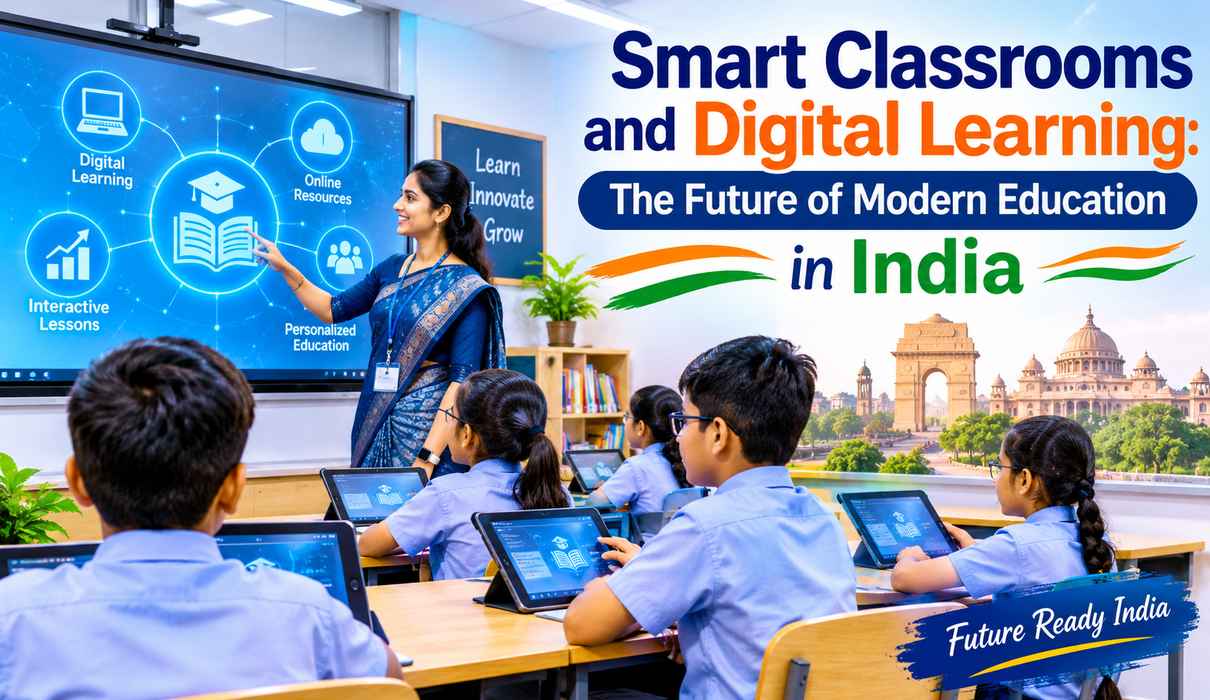
Smart Classrooms and Digital Learning: The Future of Modern Education in India
Education in India is experiencing a remarkable transformation as technology becomes an essential part of modern teaching and learning. Traditional classrooms, once dominated by blackboards, textbooks, and lectures, are gradually evolving into interactive learning environments supported by digital tools, artificial intelligence, and innovative educational technologies.
Smart classrooms and digital learning are playing an increasingly important role in transforming the Indian education system. From interactive whiteboards and online learning platforms to AI-powered educational applications and virtual classrooms, technology is creating new opportunities for students, teachers, and educational institutions.
The growing adoption of digital education in India is helping schools and colleges introduce more flexible, engaging, and personalized learning experiences. Government initiatives, expanding internet connectivity, and the development of educational technology platforms are also supporting this transformation.
As India prepares for a technology-driven future, understanding the importance of smart classrooms and digital learning is essential for improving educational quality, accessibility, and student outcomes.
What Are Smart Classrooms?
A smart classroom is a technology-enabled learning environment that uses digital devices, multimedia content, and interactive teaching tools to improve the educational experience.
Unlike traditional classrooms that primarily depend on textbooks and lectures, smart classrooms integrate modern technologies to make lessons more engaging and interactive.
Common technologies used in smart classrooms include:
- Interactive digital whiteboards and smart displays
- Projectors and multimedia teaching systems
- Computers, tablets, and digital learning devices
- High-speed internet connectivity
- Educational software and learning management systems
- Artificial intelligence-powered learning applications
- Virtual reality and augmented reality technologies
These tools allow teachers to explain complicated subjects through videos, animations, interactive presentations, and practical demonstrations.
For example, students studying human anatomy can explore interactive 3D models, while geography students can examine digital maps and virtual representations of different locations.
Smart classroom technology in India has the potential to make education more interactive, accessible, and effective when supported by appropriate teaching methods.
The Growing Importance of Digital Learning in India
Digital learning refers to educational activities supported by electronic devices, online platforms, and digital educational resources.
Over recent years, digital learning in India has expanded through online courses, educational applications, recorded lectures, and virtual classroom platforms.
Students can now access educational materials beyond conventional school hours, allowing them to revise lessons and develop additional skills at their convenience.
Several factors are contributing to the increasing importance of digital education.
1. Expanding Internet Connectivity
Improving internet connectivity is making online educational resources available to more students across India.
However, connectivity quality and affordability remain important challenges, particularly in underserved regions.
2. Growing Smartphone Adoption
Smartphones provide access to educational videos, digital textbooks, online assessments, and learning applications.
Mobile-friendly educational platforms can help students continue learning without requiring expensive computer equipment.
3. Government Digital Education Initiatives
The Indian government has introduced several programs to encourage technology-enabled education.
Initiatives such as DIKSHA, SWAYAM, and PM eVIDYA provide digital educational resources and support flexible learning opportunities.
4. Increasing Demand for Digital Skills
Modern industries increasingly require employees with technological knowledge, problem-solving abilities, and digital communication skills.
Digital learning helps students become familiar with technologies that may be useful in higher education and future employment.
Key Technologies Transforming Smart Classrooms in India
The development of educational technology is introducing innovative teaching methods into Indian schools, colleges, and universities.
1. Artificial Intelligence in Education
Artificial intelligence is becoming an important component of modern educational technology.
AI-powered learning systems can analyze student responses, recommend suitable learning materials, and provide personalized practice exercises.
For example, an AI-based mathematics application may identify topics where a student needs additional support and suggest relevant exercises.
Artificial intelligence can also assist teachers with lesson preparation, educational content creation, and routine administrative activities.
However, AI-generated information requires verification, and teachers remain essential for guiding students and evaluating learning progress.
2. Interactive Smart Boards
Interactive smart boards are replacing conventional teaching boards in some educational institutions.
These digital displays allow teachers to present multimedia lessons, write digital notes, and interact with educational applications.
Students can participate in classroom activities through interactive exercises and visual demonstrations.
Smart boards can be particularly useful for subjects that involve diagrams, calculations, scientific processes, and geographical information.
3. Virtual Reality and Augmented Reality
Virtual reality and augmented reality are introducing immersive educational experiences.
Virtual reality allows students to explore simulated environments, while augmented reality adds digital information to real-world surroundings.
For example, students can explore historical monuments through virtual tours or examine scientific models using augmented reality applications.
These technologies can support experiential learning, although equipment costs and teacher training may limit widespread adoption.
4. Cloud-Based Learning Platforms
Cloud technology allows educational institutions to store and distribute learning materials through internet-connected systems.
Teachers can upload assignments, recorded lectures, presentations, and assessments.
Students can access these resources from supported devices, making learning more flexible.
Cloud-based platforms also help schools organize educational content and maintain communication between teachers and students.
5. Learning Management Systems
Learning management systems, commonly known as LMS platforms, help educational institutions manage digital learning activities.
They support assignment distribution, attendance management, online assessments, and student progress monitoring.
An effective LMS can reduce administrative workload while improving communication and access to educational materials.
Major Benefits of Smart Classrooms and Digital Learning
The adoption of smart education technology offers several potential benefits for Indian educational institutions.
1. Improved Student Engagement
Digital presentations, educational videos, interactive quizzes, and multimedia activities can make lessons more engaging.
Students may find complex concepts easier to understand when teachers combine explanations with visual demonstrations.
Interactive learning also creates opportunities for classroom discussions and collaborative activities.
2. Personalized Learning Experiences
Students have different learning abilities, interests, and educational needs.
Digital learning platforms can provide learning resources based on individual progress and performance.
Students who require additional practice can revisit lessons, while others can explore advanced educational materials.
This flexibility can support a more inclusive learning environment.
3. Greater Access to Educational Resources
Online education platforms provide access to digital textbooks, lectures, practice materials, and skill-development courses.
Students living in areas with limited educational facilities may benefit from resources developed by institutions elsewhere in India.
Nevertheless, reliable connectivity, affordable devices, and accessible content are necessary to realize these benefits.
4. Flexible Learning Opportunities
Digital education allows students to access certain educational materials outside regular classroom hours.
Recorded lectures, downloadable notes, and online exercises help learners revise lessons according to their schedules.
This flexibility is particularly useful for exam preparation, professional courses, and supplementary learning.
5. Better Teacher Productivity
Smart classroom tools can help teachers organize lessons, prepare presentations, distribute assignments, and monitor academic progress.
Automated administrative features may reduce time spent on repetitive tasks.
Teachers can then devote more attention to classroom interaction, student support, and effective teaching strategies.
Government Initiatives Supporting Digital Education in India
The Indian government has introduced several initiatives to strengthen digital education infrastructure and expand access to educational resources.
National Education Policy 2020
The National Education Policy 2020 emphasizes the appropriate integration of technology into education.
It recognizes the importance of digital learning resources, teacher development, educational innovation, and equitable access.
The policy also highlights the need to address the digital divide and evaluate educational technologies before widespread implementation.
DIKSHA Digital Learning Platform
DIKSHA provides digital educational resources for teachers and students.
It supports access to learning materials, teacher training resources, and curriculum-related content.
The platform contributes to the broader development of technology-enabled school education.
SWAYAM Online Learning Platform
SWAYAM offers online courses across various academic disciplines.
It provides opportunities for students and other learners to access educational content from participating institutions.
Course availability, certification conditions, and credit recognition depend on the relevant program and institution.
PM eVIDYA Initiative
PM eVIDYA brings together different approaches to digital, online, and broadcast-based education.
Its purpose includes expanding access to learning resources through multiple delivery channels.
Such initiatives are particularly important where internet-based learning alone cannot reach every student.
Smart Classrooms vs Traditional Classrooms
Traditional classrooms and smart classrooms have different strengths.
Traditional teaching methods emphasize direct interaction, classroom discussion, textbooks, and teacher-led explanations.
Smart classrooms introduce digital resources that can enhance these established educational practices.
| Features | Traditional Classrooms | Smart Classrooms |
|---|---|---|
| Teaching Tools | Textbooks and boards | Digital displays and multimedia |
| Learning Resources | Primarily printed materials | Printed and digital resources |
| Student Interaction | Discussions and written exercises | Discussions and interactive activities |
| Assessment Methods | Written tests and assignments | Written and digital assessments |
| Learning Flexibility | Mainly classroom-based | Classroom and supplementary online learning |
| Educational Content | Books and teacher-prepared notes | Books, videos, simulations, and digital materials |
The most effective approach is not necessarily replacing traditional education entirely.
Instead, combining classroom teaching with suitable digital technologies can create a balanced learning environment.
Challenges of Implementing Smart Classrooms in India
Despite their advantages, smart classrooms and digital learning face several practical challenges.
Digital Divide Between Urban and Rural Areas
Access to reliable internet connections, electricity, and digital devices varies across India.
Some educational institutions have advanced technological infrastructure, while others struggle with basic facilities.
Reducing these differences is essential for equitable digital education.
High Infrastructure Costs
Smart displays, computers, networking equipment, and educational software require financial investment.
Schools must also consider maintenance, technical support, and equipment replacement costs.
Affordable and sustainable technology solutions are particularly important for institutions with limited budgets.
Need for Teacher Training
Technology alone cannot guarantee better educational outcomes.
Teachers require practical training to integrate digital tools into classroom activities effectively.
Professional development programs should focus on both technical skills and appropriate teaching methods.
Cybersecurity and Data Privacy
Digital learning platforms may collect student information, academic records, and usage data.
Educational institutions must protect this information through suitable security measures and responsible data management.
Special attention is necessary when handling children’s personal information.
Excessive Screen Time
Extended screen exposure may create concerns related to physical comfort, attention, and learning habits.
Schools should balance digital activities with reading, writing, physical movement, and face-to-face interaction.
Technology should support healthy learning practices rather than replace every traditional activity.
The Role of Teachers in Digital Education
Teachers remain central to successful educational transformation.
Although technology can provide educational content and automate selected activities, it cannot fully replace human guidance, encouragement, and classroom relationships.
Teachers help students develop critical thinking, communication abilities, creativity, and responsible technology habits.
In smart classrooms, educators increasingly act as facilitators who guide students through interactive learning experiences.
They can combine digital presentations with practical demonstrations, group discussions, and project-based assignments.
Teachers also play an important role in helping students evaluate online information and use artificial intelligence responsibly.
Continuous teacher training is therefore essential for improving the quality of digital learning in India.
How Digital Learning Supports Skill Development
Modern education must prepare students for a changing professional environment.
Digital learning can support the development of important academic, technical, and professional skills.
These include:
- Digital literacy and basic computer knowledge
- Communication and collaboration skills
- Critical thinking and problem-solving
- Coding and computational thinking
- Creativity and innovation
- Information evaluation and research skills
- Responsible use of artificial intelligence
Online courses and interactive educational platforms can supplement classroom instruction with practical learning opportunities.
Project-based activities can also help students apply theoretical knowledge to real-world situations.
However, skill development depends on the quality of instruction, student participation, and meaningful assessment rather than technology alone.
The Future of Smart Classrooms and Digital Learning in India
The future of modern education in India will likely involve greater integration of digital technologies with established teaching methods.
Several emerging trends could influence educational development over the coming years.
AI-Powered Personalized Education
Artificial intelligence may increasingly support adaptive educational platforms that recommend learning activities based on student progress.
Responsible implementation will require transparency, teacher supervision, and appropriate data protection.
Growth of Hybrid Learning
Hybrid learning combines classroom instruction with online educational resources.
This approach allows institutions to preserve face-to-face teaching while offering additional flexibility through digital platforms.
Expansion of Regional Language Content
India’s linguistic diversity creates demand for educational materials in regional languages.
Multilingual digital resources can help students understand concepts in familiar languages and improve educational accessibility.
Increased Focus on Inclusive Education
Accessible educational software, assistive technologies, and flexible content formats can support students with different learning requirements.
Inclusive design should become an important consideration when educational institutions select digital tools.
Greater Emphasis on Practical Learning
Digital simulations, collaborative projects, and interactive educational applications may create additional opportunities for practical learning.
Schools and colleges can use these technologies to connect academic subjects with real-world applications.
How Schools Can Successfully Adopt Smart Classroom Technology
Educational institutions should approach digital transformation through careful planning.
The first step is identifying educational needs rather than purchasing technology simply because it is new.
Schools should evaluate existing infrastructure, available budgets, teacher readiness, and student accessibility requirements.
Selecting reliable educational software and providing ongoing teacher training are equally important.
Institutions should also establish appropriate cybersecurity policies and procedures for maintaining digital equipment.
Regular feedback from teachers, students, and parents can help determine whether technology is improving the learning experience.
Most importantly, schools should measure success through educational outcomes, accessibility, and student engagement rather than the number of devices installed.
Conclusion
Smart classrooms and digital learning are helping shape the future of modern education in India. Interactive teaching technologies, artificial intelligence, online educational resources, and digital learning platforms are creating new possibilities for schools, colleges, teachers, and students.
Government initiatives and educational technology innovations are supporting this transition, but important challenges remain. Infrastructure costs, unequal digital access, teacher training, cybersecurity, and responsible technology use require continued attention.
The future of education will depend on combining technological innovation with effective teaching practices and inclusive educational policies.
By investing in accessible infrastructure, teacher development, and high-quality learning resources, India can create more engaging and future-ready educational environments.
Ultimately, successful digital transformation is not about replacing teachers or traditional classrooms. It is about using technology thoughtfully to improve learning opportunities and help students develop the knowledge and skills needed for the future.