

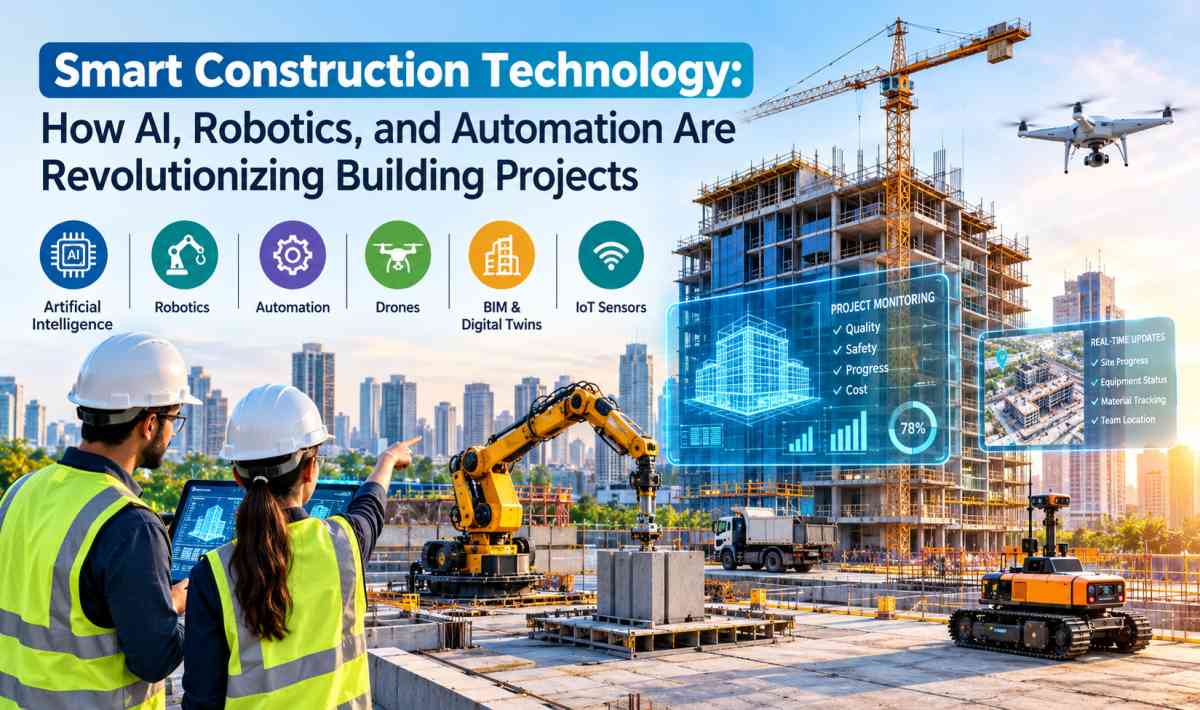
Smart Construction Technology: How AI, Robotics, and Automation Are Revolutionizing Building Projects
Introduction
The construction industry is experiencing a technological transformation as artificial intelligence, robotics, and automation introduce smarter ways to design, manage, and complete building projects. Traditional construction methods often depend on manual processes, extensive paperwork, and time-consuming coordination. However, smart construction technology is changing how construction companies approach efficiency, safety, sustainability, and project management.
From AI-powered planning software to autonomous construction equipment, advanced technologies are helping developers address common challenges such as project delays, rising material costs, labor shortages, and inefficient resource management.
In India, increasing urbanization, infrastructure development, and demand for sustainable buildings are creating opportunities for digital construction solutions. Residential developers, commercial builders, architects, and infrastructure companies are exploring technologies that improve construction quality while reducing unnecessary expenses.
As the industry moves toward 2027, integrating artificial intelligence, construction robotics, and intelligent automation could become increasingly important for competitive building projects.
This article explores how smart construction technology works, its major applications, benefits, challenges, and its potential to transform the future of construction.
What Is Smart Construction Technology?
Smart construction technology refers to the integration of digital tools, intelligent machines, connected equipment, and automated systems into construction processes.
These technologies help construction professionals monitor activities, analyze project information, improve decision-making, and automate repetitive tasks.
Unlike conventional construction methods, smart construction combines real-time data with advanced computing technologies to improve project performance.
Major components include:
- Artificial intelligence for project planning and predictive analysis.
- Robotics for repetitive and physically demanding construction activities.
- Automation for equipment operation and workflow management.
- Internet of Things sensors for equipment and site monitoring.
- Building Information Modeling for digital project coordination.
- Drones for surveying, inspections, and progress tracking.
- Digital twins for virtual building monitoring and analysis.
Together, these innovations support more connected and data-driven construction environments.
1. Artificial Intelligence Is Transforming Construction Planning
Artificial intelligence is becoming an important technology in modern construction management.
AI-powered software can analyze large amounts of project information, identify patterns, and assist construction teams with complex decisions.
AI-Powered Project Scheduling
Construction projects involve multiple activities, including design approvals, material procurement, labor allocation, equipment scheduling, and inspections.
Managing these activities manually can become complicated, particularly on large projects.
AI-supported scheduling tools can evaluate dependencies, identify potential conflicts, and suggest adjustments when project conditions change.
For example, if material delivery is delayed, intelligent scheduling software may recommend alternative work sequences to minimize disruption.
Predictive Risk Analysis
AI systems can examine historical project records, weather information, equipment performance, and construction schedules to identify possible risks.
These insights help project managers prepare for delays, budget problems, and operational challenges.
However, predictions depend on data quality and should support rather than replace professional judgment.
Construction Cost Estimation
AI-assisted estimation tools can analyze drawings, quantities, material prices, and previous project information.
This can help contractors prepare preliminary budgets and identify possible cost variations.
Human verification remains essential because market prices, design changes, and site conditions can affect final construction costs.
2. Construction Robotics Is Changing Building Site Operations
Construction robotics is another significant development within smart construction technology.
Robotic systems are designed to perform specific tasks with improved consistency, precision, or reduced physical effort.
Although construction sites are complex and constantly changing, robots are increasingly being developed for controlled and repetitive activities.
Robotic Bricklaying
Robotic bricklaying systems can assist with placing bricks or blocks according to predefined layouts.
These systems may improve consistency and reduce repetitive manual work.
However, their effectiveness depends on building design, site preparation, material compatibility, and equipment costs.
Robotic Concrete Applications
Automated concrete placement and finishing technologies can help construction teams perform selected operations more consistently.
Some robotic systems are designed for concrete surface finishing, while others support specialized printing or material deposition processes.
Demolition and Inspection Robots
Remote-controlled demolition robots can operate in environments where direct human exposure presents additional risks.
Inspection robots can also examine selected building areas, tunnels, or industrial structures.
These technologies can improve access and support safer working practices when properly operated.
Rather than completely replacing construction workers, robotics is likely to change job responsibilities and increase demand for skilled equipment operators and technicians.
3. Construction Automation Is Improving Productivity
Construction automation involves using technology to perform activities with reduced manual intervention.
It can include automated machinery, digital workflows, material handling systems, and equipment monitoring.
Automated Construction Equipment
Modern construction machinery increasingly incorporates sensors, positioning systems, and machine-control technologies.
Excavators, graders, and other equipment can use digital design information to guide selected operations.
Such systems can improve grading accuracy and reduce unnecessary rework.
Automated Material Handling
Material transportation is an essential part of construction site management.
Automated lifting equipment, guided transport systems, and intelligent logistics software can support more organized material movement.
However, automation must be designed around site conditions, worker safety, and operational requirements.
Digital Workflow Automation
Construction companies also use automation to manage administrative processes.
Digital systems can streamline document approvals, inspection records, purchase requests, and project reporting.
Reducing repetitive paperwork allows project teams to focus more attention on technical coordination and quality control.
4. Building Information Modeling Is Supporting Smarter Construction
Building Information Modeling, commonly known as BIM, is an important foundation of digital construction technology.
BIM uses structured digital building information to support planning, design, construction, and facility management.
Architects, structural engineers, contractors, and building services professionals can coordinate information through shared digital models.
Improved Design Coordination
Construction projects often involve multiple design disciplines.
Conflicts between structural elements, electrical systems, plumbing networks, and ventilation equipment can cause expensive changes during construction.
BIM-based coordination tools can identify potential clashes before installation begins.
Better Project Visualization
Three-dimensional building models help project stakeholders understand layouts, materials, and construction sequences.
When combined with scheduling information, BIM can support four-dimensional construction planning.
Cost information can also be linked to models for quantity tracking and budget analysis.
Reduced Rework
By improving coordination and identifying design inconsistencies earlier, BIM can reduce avoidable rework.
Nevertheless, successful implementation requires accurate models, trained professionals, and consistent information management.
5. IoT Sensors Are Creating Connected Construction Sites
The Internet of Things, or IoT, connects physical devices to digital systems through sensors and communication networks.
In construction, IoT devices can collect information about equipment, environmental conditions, and selected site activities.
Real-Time Equipment Monitoring
Connected machinery can provide data about operating hours, maintenance requirements, and equipment utilization.
Project managers can use this information to schedule servicing and identify underused assets.
Environmental Monitoring
Construction sites may use sensors to monitor temperature, humidity, dust, noise, and other environmental conditions.
These measurements can support compliance monitoring and better site management.
Concrete Curing Monitoring
Embedded sensors can track temperature and other relevant conditions during concrete curing.
Engineers can use this information alongside appropriate testing and engineering methods to evaluate construction progress.
Connected monitoring systems are particularly useful when reliable data is required across large or geographically distributed projects.
6. Drones Are Transforming Construction Surveying and Inspections
Drones are becoming valuable tools for construction surveying, documentation, and progress monitoring.
Equipped with cameras and suitable sensors, drones can capture aerial information from construction sites.
Faster Site Documentation
Drone imagery can help project teams observe site conditions and record construction progress.
Photogrammetry software can convert overlapping images into maps and three-dimensional representations.
Construction Progress Tracking
Regular aerial surveys allow project managers to compare visible site progress with planned construction activities.
This can help identify coordination issues and improve communication with stakeholders.
Building Inspections
Drones can support visual inspections of roofs, facades, and other difficult-to-access building surfaces.
They do not eliminate the need for qualified inspections, particularly when detailed structural assessment is required.
Drone operations must also comply with applicable aviation rules, privacy requirements, and site safety procedures.
7. 3D Printing Is Introducing New Construction Methods
Three-dimensional printing is an emerging construction technology that creates building components or structures through controlled material deposition.
In construction, specialized equipment can place suitable materials in layers according to digital design instructions.
Potential Advantages
Construction 3D printing may offer several benefits:
- Reduced dependence on conventional formwork for selected designs.
- Greater flexibility for certain architectural shapes.
- More controlled material placement.
- Opportunities to reduce waste in suitable applications.
- Faster production of specific building components.
Applications in India
India has witnessed demonstration projects and growing interest in 3D-printed buildings.
The technology is being explored for housing, specialized structures, and prefabricated construction components.
However, widespread adoption depends on structural validation, material performance, building regulations, equipment availability, and economic feasibility.
3D printing is therefore best understood as a developing construction method rather than a universal replacement for conventional building techniques.
8. Smart Construction Technology Is Improving Workplace Safety
Construction safety remains a major priority because building sites involve heavy machinery, elevated work areas, moving materials, and changing environmental conditions.
Digital technologies can support safer operations through improved monitoring and earlier identification of hazards.
AI-Assisted Safety Monitoring
Computer vision systems can analyze camera footage to identify selected safety concerns.
Depending on their capabilities, these systems may flag restricted-area access or missing protective equipment.
Wearable Safety Devices
Connected wearable devices can support worker location monitoring, environmental alerts, and emergency communication.
Their implementation should include clear privacy protections and appropriate data management.
Remote Equipment Operation
Remote-controlled machinery can reduce direct exposure to certain hazardous environments.
Nevertheless, effective safety programs still require training, supervision, equipment maintenance, and established procedures.
Technology should strengthen existing safety practices rather than create false confidence.
9. Sustainable Construction Is Benefiting From Intelligent Technology
Sustainability is becoming increasingly important in residential, commercial, and infrastructure development.
Smart construction technology can help reduce unnecessary resource consumption and improve environmental performance.
Material Optimization
Digital design tools can help engineers evaluate material quantities and compare alternative construction approaches.
More accurate quantity estimation can reduce overordering and unnecessary waste.
Energy-Efficient Construction
Connected equipment monitoring can help construction managers identify inefficient machinery use.
Digital scheduling may also improve equipment coordination and reduce avoidable idle time.
Waste Management
Construction waste can be tracked through digital reporting systems.
This information helps companies identify opportunities for reuse, recycling, and improved procurement.
Sustainable Building Performance
When construction information is connected with building management systems, it can support long-term facility operations.
Digital twins and intelligent monitoring may help building owners understand energy consumption and maintenance needs.
The environmental benefits of these technologies depend on how effectively they are implemented.
10. Benefits of Smart Construction Technology for Businesses
Smart construction technology offers several potential advantages for developers, contractors, architects, and project owners.
Improved productivity: Automation and digital coordination can reduce repetitive activities and help teams manage workflows more effectively.
Better cost control: Accurate project information and timely reporting can help identify unnecessary expenses before they increase.
Higher construction quality: Digital models, monitoring systems, and automated equipment can support more consistent execution.
Improved collaboration: Shared project information allows architects, engineers, contractors, and clients to coordinate decisions.
Reduced project delays: Predictive analysis and improved scheduling can help teams respond to changing conditions.
Greater transparency: Digital records provide clearer information about progress, approvals, and project responsibilities.
However, these advantages are not automatic. Results depend on suitable technology selection, staff training, implementation quality, and project complexity.
11. Challenges of Implementing Smart Construction Technology
Despite its potential, smart construction technology faces several adoption challenges.
High Initial Investment
Advanced machinery, robotics, software licenses, and digital infrastructure can require substantial upfront expenditure.
Smaller contractors may find these costs difficult to justify without clear financial benefits.
Skilled Workforce Requirements
AI tools, BIM platforms, and automated equipment require trained professionals.
Companies must invest in workforce development and practical technical education.
Data Integration Problems
Different software platforms may use incompatible formats or information structures.
Poor integration can reduce the usefulness of connected construction systems.
Cybersecurity and Privacy
Connected construction equipment and cloud-based project platforms create additional data security responsibilities.
Companies need appropriate access controls, cybersecurity procedures, and privacy safeguards.
Resistance to Change
Traditional working practices can make digital transformation difficult.
Successful adoption requires management support, clear communication, and realistic implementation plans.
12. Future of Smart Construction Technology in India
India’s construction industry has opportunities to adopt intelligent technologies as demand grows for housing, commercial properties, transportation infrastructure, and sustainable buildings.
Over the coming years, several developments could influence the sector.
AI-assisted project management may become more accessible through integrated construction software.
BIM adoption could expand as organizations seek better design coordination and project information management.
Robotic equipment may become more common in repetitive or specialized construction operations.
IoT-based monitoring could support equipment maintenance, site management, and building performance analysis.
Prefabrication and modular construction may also benefit from automated manufacturing processes.
However, adoption will likely vary between large infrastructure developers, established construction companies, and smaller contractors.
Affordability, training, regulations, and measurable project benefits will determine how quickly these technologies become widespread.
13. How Construction Companies Can Adopt Smart Technology
Construction businesses do not need to implement every emerging technology simultaneously.
A gradual approach can make digital transformation more practical.
Companies should begin by identifying recurring problems such as inaccurate reporting, equipment downtime, design conflicts, or material wastage.
They can then select technologies that address these specific challenges.
For example, BIM may be suitable for projects experiencing design coordination problems, while equipment monitoring systems may benefit contractors managing large machinery fleets.
Pilot projects allow businesses to evaluate performance before making larger investments.
Employee training, cybersecurity planning, and clear performance indicators should be included throughout implementation.
The most effective strategy is to prioritize technologies that deliver measurable improvements rather than adopting innovations simply because they are new.
Conclusion
Smart construction technology is reshaping the future of building projects by introducing more connected, automated, and data-driven construction methods.
Artificial intelligence supports planning and risk analysis, robotics assists with specialized physical tasks, and automation improves selected operational processes.
Meanwhile, BIM, IoT sensors, drones, and 3D printing are creating new opportunities for construction coordination, monitoring, and innovation.
For India’s construction industry, these technologies could help address challenges involving productivity, project delays, resource efficiency, and infrastructure development.
Although implementation requires investment, skilled professionals, and careful planning, the long-term opportunities are significant.
As construction companies prepare for 2027 and beyond, businesses that adopt suitable digital technologies while maintaining strong engineering and safety standards will be better positioned to deliver efficient, reliable, and sustainable building projects.