

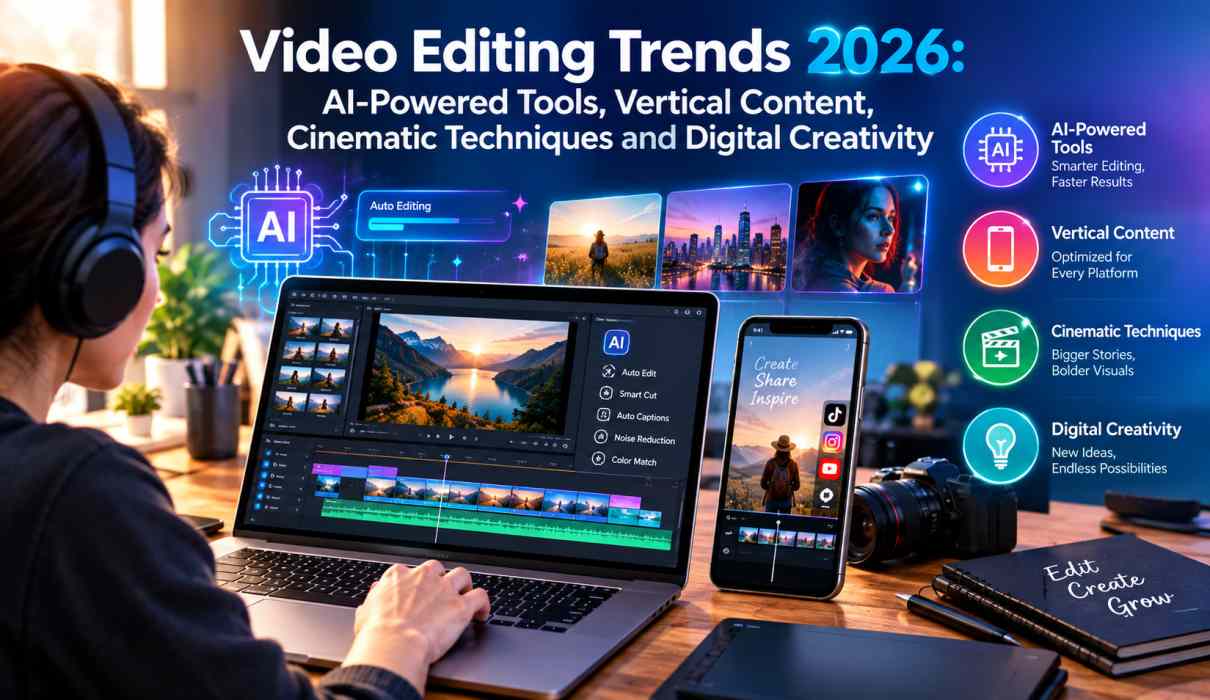
Video Editing Trends 2026: AI-Powered Tools, Vertical Content, Cinematic Techniques and Digital Creativity
Video editing is changing rapidly in 2026 as artificial intelligence, social media, mobile-first content and advanced creative technologies reshape the way videos are produced. What once required hours of manual cutting, color correction, audio mixing and captioning can now be accelerated through intelligent editing tools and automated workflows.
At the same time, technology has not replaced the importance of creativity. Strong storytelling, pacing, visual composition, sound design and audience understanding remain essential to producing memorable video content.
From YouTube videos and social media Reels to advertisements, corporate films, documentaries and cinematic productions, modern editors are using a combination of AI-powered tools and traditional editing techniques to work faster and create more engaging experiences.
Adobe’s 2026 Premiere updates, for example, include AI-assisted media organization, text-based editing, object masking, generative media, automatic captions and tools for adapting content to different aspect ratios.
This article explores the major video editing trends 2026, including AI-powered editing, vertical content, cinematic techniques, automated workflows, social media optimization and the growing role of digital creativity.
1. AI-Powered Video Editing Becomes a Major Trend
Artificial intelligence is becoming one of the most important developments in modern video editing.
Instead of requiring editors to perform every repetitive task manually, AI can assist with organizing footage, generating transcripts, finding clips, detecting scenes, improving audio and creating rough edits.
Modern editing platforms are increasingly integrating AI directly into their timelines. Adobe’s Premiere, for example, provides AI-powered features such as Object Mask, Media Intelligence, Text-Based Editing, Enhance Speech, Auto Reframe and Generative Extend.
In 2026, editors can increasingly use natural-language instructions to interact with editing software. Adobe’s Premiere AI Assistant, currently available in beta, is designed to help organize footage, prepare media and assemble initial edits through simple prompts.
The important change is not simply that AI can edit video. Rather, AI is becoming an assistant inside the editing workflow.
Editors can spend less time searching through hundreds of clips and more time deciding how the story should feel.
2. AI-Assisted Rough Cuts and Automated Workflows
Creating a rough cut can be one of the most time-consuming stages of video production. Editors often need to watch large amounts of footage before identifying useful moments.
AI is making this process more efficient.
Text-based editing can automatically transcribe spoken content and allow editors to create rough cuts by working with text. This is particularly useful for interviews, podcasts, educational videos, webinars and documentaries.
Editors can search transcripts, remove unnecessary sections and quickly assemble a preliminary sequence before refining the visual edit. Adobe describes its Text-Based Editing workflow as a way to create rough cuts by cutting and pasting transcript text.
This trend is likely to become increasingly important for creators producing large volumes of content.
For example, a one-hour interview could be transformed into a long-form video, several short clips, social media highlights and quote-based videos without rebuilding the entire project manually.
3. Vertical Video Continues to Shape Editing
The rise of mobile-first viewing has made vertical video one of the defining formats of modern digital content.
Short-form videos designed for platforms such as Instagram Reels, TikTok and YouTube Shorts require different editing decisions from traditional widescreen videos.
Editors increasingly need to consider:
- 9:16 vertical composition
- Fast openings
- Large readable captions
- Close-up framing
- Rapid transitions
- Mobile-friendly graphics
- Strong visual hooks
- Shorter storytelling sequences
A horizontal video cannot simply be cropped into a vertical format without considering composition. Subjects may move outside the frame, important background information can disappear and graphics may become difficult to read.
AI-assisted reframing is helping address this challenge. Adobe’s Auto Reframe can identify the focal point of action and keep it visible when changing aspect ratios.
As brands and creators increasingly publish the same campaign across multiple platforms, flexible aspect-ratio editing will remain an important part of the workflow.
4. Short-Form Video Editing Becomes More Dynamic
Short-form content has changed the rhythm of digital video.
Editors increasingly use quick cuts, animated captions, zooms, sound effects, visual transitions and movement to maintain attention.
However, effective short-form editing is not simply about making every second extremely fast. Good editors understand when to accelerate a sequence and when to allow a moment to breathe.
In 2026, successful short-form editing combines speed with storytelling.
A strong structure may include:
Hook → Context → Development → Payoff → Call to action
The first few seconds are particularly important because viewers can quickly move to another piece of content.
Animated captions are also becoming increasingly sophisticated. Adobe’s 2026 updates include single-word animated captions designed specifically for fast-paced social videos.
This reflects a wider trend toward making captions part of the visual design rather than treating them simply as subtitles.
5. Cinematic Editing Techniques Remain Important
Despite the growth of AI and automated editing, cinematic storytelling remains a major creative direction in 2026.
Creators are increasingly applying film-inspired techniques to advertisements, travel videos, YouTube productions, brand films and social content.
Popular techniques include:
- Controlled pacing
- Creative camera movement
- Cinematic color grading
- Depth and layering
- Match cuts
- Motivated transitions
- Slow-motion sequences
- Sound-driven editing
- Creative framing
- Visual continuity
Cinematic editing is ultimately about creating emotion and guiding the viewer through a story.
Technology can help identify clips or automate technical corrections, but creative decisions about mood, timing and narrative still depend heavily on the editor.
Modern editing platforms are also expanding their cinematic capabilities. Adobe’s current Premiere features include advanced masking, effects, transitions, color tools and AI-assisted workflows intended to reduce technical workload while preserving creative control.
6. AI-Generated Video and Creative Assets
One of the most significant developments in 2026 is the increasing integration of generative AI into video-production workflows.
Editors can now experiment with AI-generated video clips, sound effects, visual concepts and other assets without necessarily leaving their editing environment.
Adobe’s September 2026 Premiere update introduced a Generative Media Tool that can generate video and sound effects directly within the timeline. Generated media can then be added as editable clips for further refinement.
This can be useful for filling gaps, creating conceptual visuals, developing transitions or experimenting with ideas during post-production.
However, creative professionals still need to review generated material carefully. Consistency, realism, copyright considerations, brand requirements and storytelling quality all need human attention.
The emerging model is therefore not simply “AI creates everything.” Instead, it is human creativity supported by intelligent generation tools.
7. Smarter Audio Editing
Good video depends heavily on good sound.
Viewers may tolerate an imperfect visual more easily than unclear dialogue or distracting background noise.
AI-powered audio tools are therefore becoming increasingly valuable in modern video editing.
Editors can use intelligent tools to improve dialogue, reduce background noise, balance music and speech, categorize audio and synchronize music with video.
For example, Adobe’s Enhance Speech is designed to improve dialogue clarity and reduce unwanted background noise, while Auto Ducking can lower background music when dialogue is present.
This is particularly useful for vloggers, interview creators, journalists, educators and filmmakers who record in unpredictable environments.
Better audio automation allows editors to spend more time on sound design and storytelling rather than repetitive technical adjustments.
8. Automated Captions and Multilingual Video
Captions are becoming an essential part of modern video publishing.
Many viewers watch videos without sound, while captions also improve accessibility and help content reach audiences who speak different languages.
AI-powered speech-to-text technology can automatically create transcripts and captions, reducing the amount of manual work required.
Modern editing platforms are also expanding multilingual capabilities. Adobe Premiere supports AI-assisted caption translation across numerous languages, helping creators adapt videos for international audiences.
For businesses, this creates opportunities to turn one video into multiple language versions.
For creators, multilingual editing can make educational, entertainment and informational content accessible to a wider audience.
9. Repurposing One Video Across Multiple Platforms
Content repurposing is becoming a major part of efficient video production.
Instead of creating every video separately, editors can take one piece of long-form content and transform it into multiple formats.
For example, a 30-minute interview could become:
- A YouTube video
- Several YouTube Shorts
- Instagram Reels
- TikTok clips
- LinkedIn videos
- Quote graphics
- Caption-based social posts
- Audio podcast segments
This approach allows creators and businesses to maximize the value of original footage.
AI-assisted search, transcription and reframing can make this process faster. Tools such as Media Intelligence can help editors locate relevant footage using descriptive searches, while Auto Reframe helps adapt compositions for different aspect ratios.
The result is a more efficient content ecosystem where one production can support an entire digital marketing campaign.
10. Motion Graphics and Visual Effects Become More Accessible
Motion graphics are another important part of modern video editing.
Animated titles, lower thirds, infographics, kinetic typography, transitions and visual effects can transform ordinary footage into more engaging content.
In 2026, advanced effects are becoming easier to use through improved templates, AI-assisted masking and more intuitive creative tools.
This does not mean every video needs complicated effects.
Instead, professional editors increasingly use motion graphics strategically to explain information, highlight important points or strengthen brand identity.
Simple animation can often communicate more effectively than excessive visual effects.
11. Mobile and Cloud-Based Editing
Video editing is no longer limited to a traditional desktop workstation.
Mobile devices, laptops and cloud-connected workflows allow creators to work from different locations.
This is particularly useful for social media creators, journalists, marketers and businesses that need rapid turnaround.
Cloud collaboration also allows multiple people to participate in the same production process.
Editors, producers, designers and clients can review content, provide feedback and manage assets without always being physically present in the same location.
As remote production continues to develop, collaboration and cloud-based workflows are likely to become increasingly important.
12. Personalized Editing for Different Audiences
Another emerging trend is personalized video content.
Instead of creating one identical video for everyone, brands can increasingly adapt videos for different audiences, languages, regions or platforms.
For example, a company could create different versions of the same promotional campaign for:
- Different countries
- Different languages
- Different age groups
- Different social platforms
- Different customer interests
AI-assisted translation, captions, reframing and editing can reduce the technical workload involved in producing these variations.
Personalization therefore becomes more practical for organizations producing large volumes of digital content.
13. Human Creativity Still Matters
One of the most important video editing trends in 2026 is the continuing importance of the human editor.
AI can accelerate repetitive tasks, but editing is more than cutting clips together.
Editors make creative decisions about:
- Storytelling
- Emotion
- Rhythm
- Character
- Visual identity
- Music
- Composition
- Audience expectations
A technically perfect video can still feel boring if it lacks a meaningful story.
The strongest workflows therefore combine automation with human judgment.
AI can help an editor find a shot, but the editor decides whether that shot belongs in the story.
14. Video Editing Skills for the Future
As editing software becomes more automated, professional editors will need to develop a broader combination of technical and creative skills.
Important skills for 2026 include AI-assisted editing, storytelling, color grading, sound design, motion graphics, short-form editing, vertical composition and platform-specific content creation.
Editors should also learn how to evaluate AI-generated material critically.
Understanding copyright, content authenticity, privacy, data security and responsible use of generative AI will become increasingly important as AI becomes more deeply integrated into creative production.
The future editor is therefore likely to be both a creative storyteller and an intelligent workflow manager.
15. The Future of Video Editing
The future of video editing is likely to be faster, more flexible and increasingly intelligent.
AI will continue automating repetitive work, while editors concentrate on storytelling and creative direction. Generative tools may help create missing footage, sound effects and visual concepts. Automated transcription and captioning will simplify accessibility and multilingual publishing.
At the same time, vertical video and short-form storytelling will continue influencing editing styles.
Cinematic techniques will remain important because audiences still respond to emotion, atmosphere and strong visual storytelling.
The biggest opportunity is the combination of these technologies.
Imagine a workflow where an editor imports hours of footage, AI organizes the material, transcripts every conversation, identifies useful moments, creates a rough sequence, generates missing visual elements, improves dialogue, creates captions, adapts the video to vertical formats and prepares multiple versions for different platforms.
The editor can then focus on what technology cannot easily replace: creative judgment and storytelling.
Conclusion
Video Editing Trends 2026 demonstrate how quickly the creative industry is evolving. AI-powered tools, vertical content, cinematic techniques, automated captions, smart audio editing, generative media and multi-platform workflows are transforming the modern post-production process.
AI is making video editing faster by reducing repetitive tasks and helping creators manage increasingly large amounts of content. At the same time, short-form and vertical video are changing how stories are structured for mobile audiences.
Cinematic editing remains important because technology alone cannot create emotional storytelling. Color, sound, pacing, composition and narrative continue to define high-quality video.
For creators, marketers, filmmakers and businesses, the key opportunity in 2026 is to combine new technology with human creativity. The most effective video workflows will not necessarily be those that use the most AI, but those that use intelligent tools thoughtfully while maintaining a clear creative vision.
As video continues to dominate digital communication, learning modern editing techniques and understanding AI-powered workflows can help creators produce content that is faster to make, easier to distribute and more engaging for audiences around the world.