

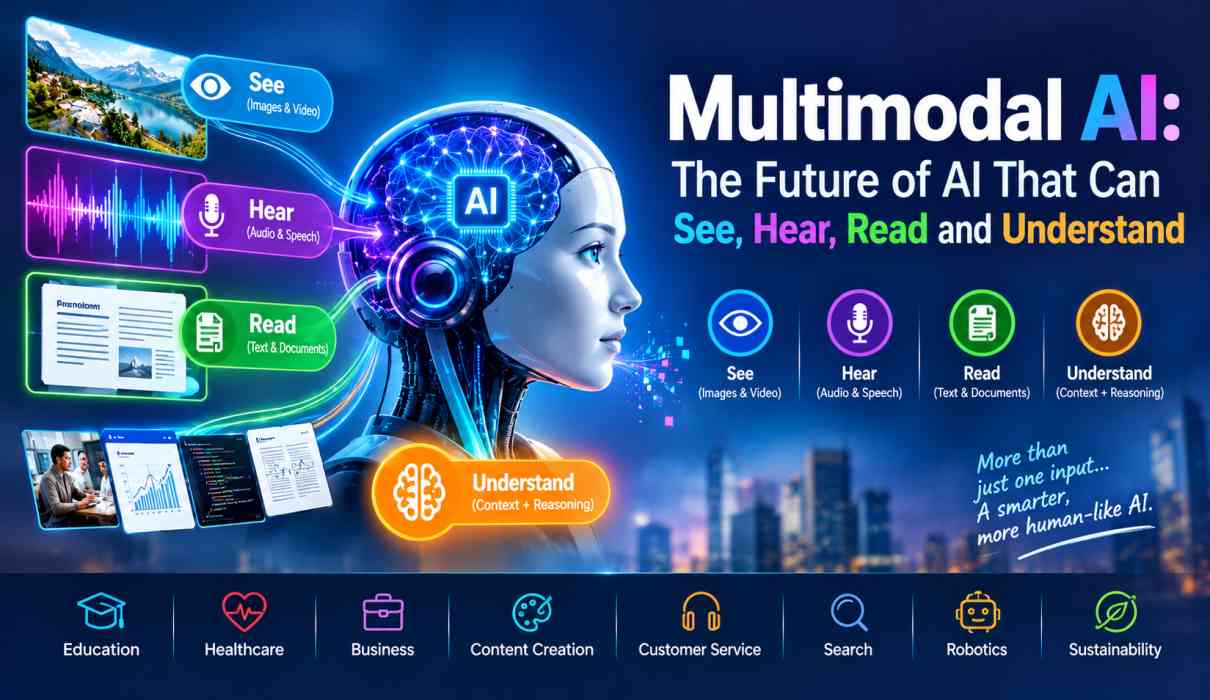
Multimodal AI: The Future of AI That Can See, Hear, Read and Understand
Artificial intelligence is moving beyond simple text-based conversations. The next major evolution is multimodal AI, a technology that allows AI systems to understand and work with multiple types of information, including text, images, audio, video, documents, and other data formats.
Traditional AI applications often focused on one type of input. A speech recognition system could understand spoken words, while a computer vision model could analyze images. Multimodal AI brings these capabilities together, allowing one AI system to connect information from different sources and use it to produce a more complete response.
This shift is already influencing search, education, healthcare, customer service, content creation, software development, robotics, and business automation. Modern AI models from companies such as OpenAI and Google demonstrate increasingly broad multimodal capabilities across text, vision, audio, and video.
What Is Multimodal AI?
Multimodal AI is artificial intelligence that can understand, process, and sometimes generate information in multiple formats or “modalities.”
These modalities can include:
- Text
- Images
- Audio
- Video
- Documents
- Code
- Charts and diagrams
For example, instead of simply asking an AI a question through text, a user could upload a photograph, provide a written instruction, and add a voice explanation. A multimodal AI system can combine these inputs to understand the overall request.
Google describes multimodal models as systems capable of processing information such as text, images, and audio and converting those inputs into different types of outputs.
This makes AI interaction more similar to the way humans communicate. People do not rely only on written language. We look at objects, listen to conversations, read documents, watch events, and combine all of this information when making decisions.
How Does Multimodal AI Work?
Multimodal AI uses advanced machine learning models to represent and connect information from different data types.
A simplified workflow looks like this:
Input → Understand Different Modalities → Combine Context → Reason → Generate Output
Imagine uploading a product photograph and asking:
“Describe this product, identify its visible features, and create a short advertisement.”
The AI needs to:
- Analyze the image.
- Identify objects and visual characteristics.
- Understand the written instruction.
- Connect the visual information with the language request.
- Generate an appropriate response.
More advanced systems can also process audio and video alongside text and images.
Some newer models are designed to support multimodal processing natively rather than treating every modality as a completely separate task. For example, OpenAI describes multimodality as the ability to understand and generate information using different combinations of text, images, audio, and video.
Why Is Multimodal AI Becoming Important?
The biggest advantage of multimodal AI is context.
A single source of information may not provide enough context to solve a problem. Combining multiple sources can give an AI system a broader understanding of what is happening.
For example, consider a technician inspecting a machine. A text description may explain the problem, but a photograph can show the physical condition while an audio recording may capture an unusual sound.
A multimodal AI system could potentially analyze these different inputs together.
This capability is particularly useful in situations where information naturally exists in different formats.
Multimodal AI vs Traditional AI
Traditional AI systems are often designed around specific tasks.
A speech-to-text model converts speech into text. A computer vision model analyzes images. A language model works primarily with text.
Multimodal AI attempts to connect these capabilities.
| Traditional AI | Multimodal AI |
|---|---|
| Often focuses on one data type | Works across multiple data types |
| Text, image, or audio may be handled separately | Different inputs can be combined |
| Limited cross-format context | Greater contextual understanding |
| Separate tools may be required | One system can handle multiple modalities |
| Interaction is often task-specific | Interaction can be more natural |
This does not mean multimodal AI is automatically more accurate in every situation. Different models have different strengths and limitations, and complex inputs can introduce new opportunities for errors.
Major Applications of Multimodal AI
1. Education
Multimodal AI can make digital learning more interactive.
A student could provide a photograph of a diagram and ask for an explanation. An AI tutor could combine written questions, visual examples, and spoken explanations.
Teachers could also use multimodal systems to create learning materials from documents, presentations, images, and recorded lessons.
The important development is that learning does not have to remain limited to text-based questions and answers.
2. Healthcare
Healthcare generates enormous amounts of information in different formats, including medical images, reports, clinical notes, and other records.
Multimodal AI research is exploring how systems can connect information from different sources to support analysis and decision-making.
However, medical AI requires particularly strong validation, privacy protection, human oversight, and regulatory safeguards. AI-generated information should not automatically be treated as a medical diagnosis.
3. Content Creation
Content creators are among the major potential beneficiaries of multimodal AI.
A creator could provide:
- A written idea
- Reference images
- A voice recording
- Existing video clips
- A content brief
An AI system could then help transform these materials into scripts, captions, storyboards, images, or video concepts.
The growing connection between multimodal understanding and generative AI is already visible in current AI tools. Google’s latest multimodal systems, for example, support combinations of text, image, audio, and video inputs for various tasks.
4. Customer Service
Customer support can involve text messages, voice calls, screenshots, documents, and product information.
A multimodal AI assistant could potentially understand a customer’s written complaint while also examining a screenshot of an error message.
This can reduce the need for customers to explain the same problem repeatedly.
Voice-based AI can make the interaction even more natural, particularly when systems can process spoken language in real time.
5. Business and Productivity
Businesses produce information through emails, PDFs, spreadsheets, presentations, meetings, photographs, and videos.
Multimodal AI can help organizations work across these formats.
For example, an employee might provide a presentation, meeting recording, and written notes and ask an AI system to create a structured summary and list of follow-up tasks.
This can make information easier to search, organize, and reuse.
6. Search and Information Discovery
Search is also becoming increasingly multimodal.
Instead of typing a long description of an object, users can upload an image and ask questions about it. A video can become a source of searchable information, while voice can become another way to interact with search systems.
This creates the possibility of a more natural search experience where users can combine text, images, speech, and other information instead of relying exclusively on keywords.
7. Robotics and the Physical World
One of the most exciting areas for multimodal AI is robotics.
A robot operating in the real world needs to understand what it sees, interpret instructions, recognize objects, and respond to changing conditions.
Google DeepMind has highlighted multimodal reasoning as an important foundation for robotics, where AI needs to comprehend and react to the physical environment rather than operating only in a digital setting.
This could eventually support robots that interact more naturally with people and environments.
Multimodal AI and Generative AI
Multimodal AI and generative AI are closely connected, but they are not exactly the same thing.
Generative AI focuses on creating new content such as text, images, audio, music, or video.
Multimodal AI focuses on understanding and working across different types of information.
A system can combine both capabilities.
For example, an AI could:
See → Understand → Reason → Generate
A user might upload a photograph of a room and ask for design suggestions. The system first needs to understand the image and then generate a text response or potentially visual design concepts.
This combination is one reason multimodal AI is becoming an important part of the next generation of AI applications.
Benefits of Multimodal AI
Better Context
Combining different information types can provide more context than relying on one format.
More Natural Interaction
People can communicate using speech, images, text, and visual references. Multimodal AI can support similar interactions.
Improved Accessibility
Voice interaction, image understanding, text processing, and other capabilities can provide alternative ways to interact with technology.
Greater Productivity
AI systems can work with different business documents and media formats, reducing the need to manually convert information between formats.
New Creative Possibilities
Creators can combine text, images, audio, and video to develop new types of digital content.
Challenges and Limitations
Despite its potential, multimodal AI has significant challenges.
Accuracy
AI can misunderstand an image, misinterpret speech, incorrectly read a document, or draw the wrong conclusion from combined information.
Privacy
Images, recordings, documents, and videos can contain sensitive information. Organizations need appropriate privacy and security controls when processing such data.
Bias
AI models can inherit biases from their training data. These biases can affect how systems interpret people, images, language, and situations.
High Computing Requirements
Processing several data types can require substantial computing resources. This can affect cost, speed, and infrastructure requirements.
Deepfake and Misinformation Risks
As AI becomes better at understanding and generating multimedia, distinguishing authentic content from synthetic content can become more difficult.
Responsible deployment therefore requires safeguards, transparency, testing, and human oversight.
The Future of Multimodal AI
The future of multimodal AI is likely to involve increasingly seamless interaction between humans and machines.
Instead of opening separate applications for text, images, speech, video, and documents, users may interact with a single AI assistant capable of working across these formats.
Current AI development already points in this direction. OpenAI’s research describes multimodal systems spanning vision, audio, language, and real-time interaction, while Google’s current models support combinations of text, image, audio, video, and document inputs.
The next stage could involve AI systems that not only understand multiple modalities but also connect them with external tools and take actions.
For example, an AI assistant could understand a spoken request, inspect an image, analyze a document, search relevant information, create a report, and interact with software.
This could make AI assistants significantly more useful for professional and everyday tasks.
Multimodal AI and the Future of Work
Multimodal AI is likely to change how people interact with software rather than simply replacing individual applications.
Employees may increasingly communicate with AI through natural language, screenshots, voice recordings, documents, and visual instructions.
This could be particularly useful for fields such as:
- Marketing
- Design
- Education
- Software development
- Customer support
- Research
- Media production
- Business operations
- Engineering
- Data analysis
The most valuable skill may not simply be knowing how to use one AI tool. It may be understanding how to combine human judgment with AI capabilities across different types of information.
Frequently Asked Questions
What is multimodal AI?
Multimodal AI is artificial intelligence that can process and understand multiple types of information, such as text, images, audio, video, and documents.
How is multimodal AI different from generative AI?
Generative AI focuses on creating content, while multimodal AI focuses on working across multiple information types. The two technologies can be combined in the same AI system.
Can multimodal AI understand images?
Yes. Modern multimodal AI models can analyze visual information and connect it with text or other inputs, although accuracy varies depending on the model and task.
Can multimodal AI understand audio?
Yes. Modern multimodal systems can process spoken language and other audio information. Some systems also support real-time voice interaction.
Is multimodal AI the future of artificial intelligence?
Multimodal AI is an important direction in current AI development because real-world information naturally exists in multiple formats. However, its future development will depend on improvements in accuracy, cost, safety, privacy, and reliability.
Conclusion
Multimodal AI represents a major evolution in artificial intelligence. Instead of interacting with AI through text alone, users can increasingly communicate through images, speech, video, documents, and other forms of information.
Its applications extend from education and content creation to business, healthcare, search, customer service, robotics, and productivity. At the same time, challenges involving accuracy, privacy, bias, security, computing requirements, and misinformation must be addressed responsibly.
As AI models become better at connecting different types of information, the boundary between human communication and machine interaction may become increasingly natural.
The future of AI is not simply about machines that can generate better text. It is about systems that can see, hear, read, understand, reason, and work across different forms of information.
That is what makes multimodal AI one of the most important technologies to watch in the next generation of artificial intelligence.
Primary SEO Keywords: Multimodal AI, multimodal artificial intelligence, multimodal AI technology, future of AI, AI that can see and hear, AI vision and audio, multimodal AI applications
Related Keywords: generative AI, AI models, artificial intelligence trends, AI in business, AI automation, AI technology, computer vision, AI voice technology, future of artificial intelligence