

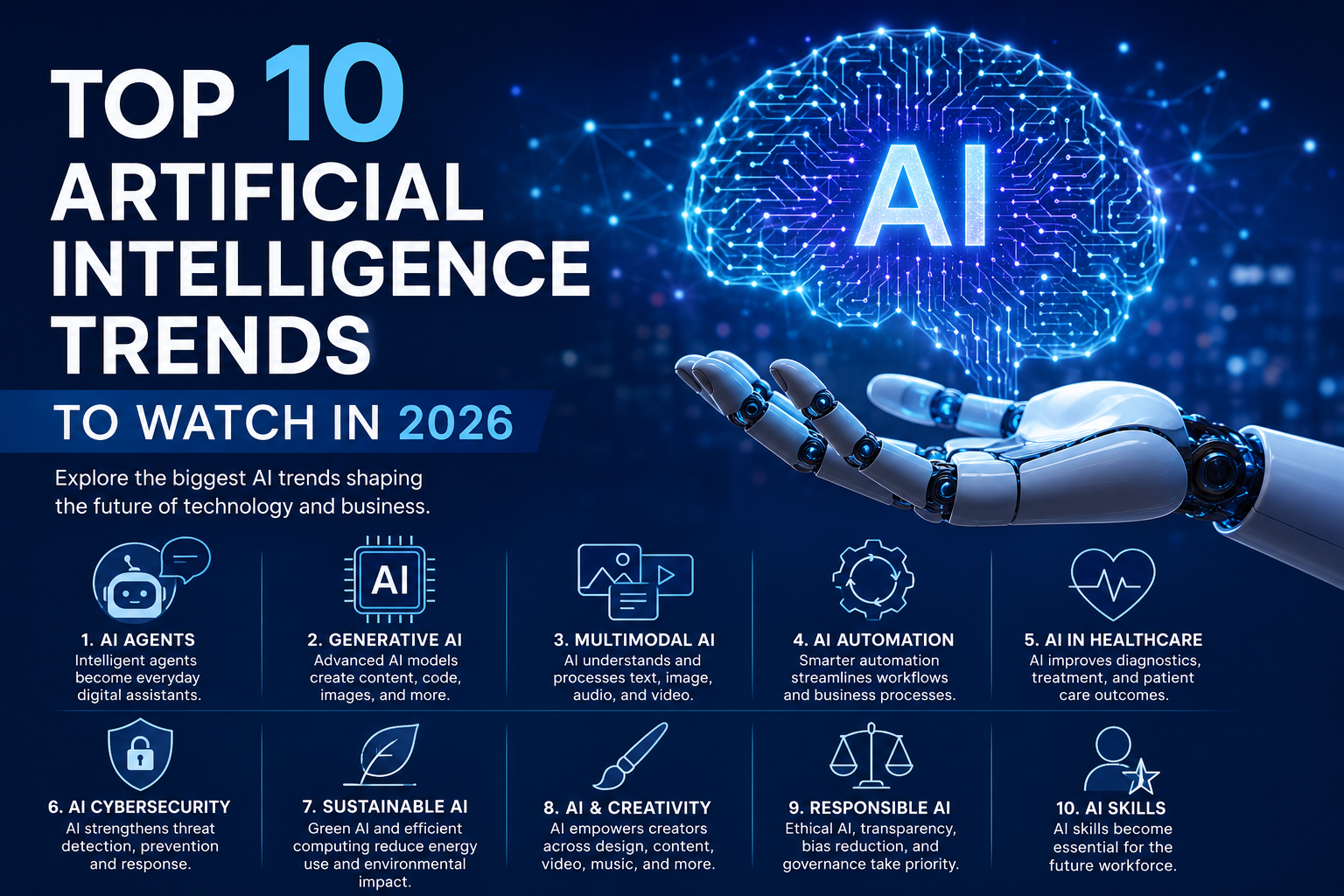
Artificial Intelligence (AI) continues to reshape the way people live, work, and interact with technology. What was once considered a futuristic concept has become an essential part of daily life, powering everything from virtual assistants and personalized recommendations to advanced business automation and scientific research. As we move through 2026, AI is evolving at an incredible pace, introducing smarter systems, more efficient workflows, and exciting innovations across every industry.
Businesses, developers, educators, healthcare providers, and creative professionals are rapidly adopting AI to improve productivity, reduce operational costs, and deliver better user experiences. Staying informed about the latest Artificial Intelligence trends 2026 can help organizations prepare for the future and remain competitive in an increasingly digital world.
Here are the ten biggest AI trends that are shaping the future.
1. AI Agents Become Everyday Digital Assistants
One of the most significant developments in 2026 is the rise of AI agents. Unlike traditional chatbots that simply answer questions, AI agents can plan, reason, and complete complex tasks with minimal human input.
These intelligent assistants can:
- Schedule meetings
- Research information
- Create reports
- Manage emails
- Automate business workflows
- Coordinate multiple applications
AI agents are becoming valuable productivity partners for businesses and individuals alike.
2. Generative AI Continues to Expand
Generative AI remains one of the fastest-growing technologies in 2026. Modern AI models can generate high-quality text, images, videos, music, presentations, and even software code within seconds.
Businesses are using generative AI to:
- Create marketing content
- Design products
- Generate architectural concepts
- Produce educational materials
- Improve customer engagement
As AI models become more advanced, the quality of generated content continues to improve dramatically.
3. Multimodal AI Takes Center Stage
Modern AI systems are no longer limited to understanding text alone.
Multimodal AI can process multiple types of information simultaneously, including:
- Text
- Images
- Audio
- Video
- Documents
- Voice commands
This enables more natural interactions and significantly improves the accuracy of AI-powered applications in healthcare, education, customer service, and design.
4. AI Automation Transforms Business Operations
Automation has moved beyond repetitive tasks. In 2026, AI is helping organizations automate entire business processes.
Companies now use AI to:
- Process invoices
- Analyze customer data
- Detect fraud
- Manage inventory
- Generate financial reports
- Optimize supply chains
These intelligent systems save time while improving efficiency and reducing human error.
5. AI Is Revolutionizing Healthcare
Healthcare continues to be one of the biggest beneficiaries of artificial intelligence.
AI supports medical professionals by:
- Detecting diseases earlier
- Analyzing medical images
- Predicting patient risks
- Assisting with drug discovery
- Personalizing treatment plans
Hospitals and healthcare providers are increasingly integrating AI to improve patient outcomes while reducing operational costs.
6. AI-Powered Cybersecurity Becomes Essential
As cyber threats become more sophisticated, AI is playing a critical role in digital security.
Modern AI security platforms can:
- Detect unusual behavior
- Identify malware
- Monitor network traffic
- Prevent phishing attacks
- Respond to threats in real time
Organizations are investing heavily in AI-powered cybersecurity solutions to protect sensitive data and maintain business continuity.
7. Sustainable AI and Green Computing Gain Momentum
Environmental sustainability is becoming a priority in AI development.
Technology companies are focusing on:
- Energy-efficient AI models
- Reduced computing power
- Lower carbon emissions
- Optimized data centers
- Responsible AI infrastructure
Green AI aims to deliver powerful performance while minimizing environmental impact, making artificial intelligence more sustainable for the future.
8. AI Enhances Creativity Across Industries
Artificial intelligence is no longer limited to technical applications. It has become a valuable creative partner.
Designers, marketers, architects, filmmakers, and musicians now use AI to:
- Generate creative concepts
- Produce realistic images
- Edit videos
- Compose music
- Design buildings
- Develop advertising campaigns
Rather than replacing human creativity, AI accelerates the creative process and helps professionals explore new ideas.
9. Responsible AI and Governance Become a Priority
As AI adoption grows, governments and organizations are placing greater emphasis on ethical AI development.
Key focus areas include:
- Transparency
- Fairness
- Data privacy
- Bias reduction
- Regulatory compliance
- Explainable AI
Responsible AI practices help build trust among users while ensuring that AI systems are developed and deployed ethically.
10. AI Skills Become Essential for Every Profession
Artificial intelligence is transforming the workplace, creating demand for new skills across nearly every industry.
Professionals are increasingly learning:
- Prompt engineering
- AI-assisted content creation
- Data analysis
- Machine learning fundamentals
- AI workflow automation
- AI-powered productivity tools
Organizations are also investing in employee training to help teams effectively use AI in their daily work.
What These Trends Mean for Businesses
Businesses that embrace AI early are gaining significant advantages. From improving customer experiences to streamlining operations, AI is becoming a key driver of innovation and growth.
Companies adopting AI can benefit from:
- Increased productivity
- Better decision-making
- Faster product development
- Lower operational costs
- Improved customer satisfaction
- Enhanced competitiveness
However, successful AI adoption also requires proper planning, employee training, and responsible governance.
The Future of Artificial Intelligence
The pace of AI innovation shows no signs of slowing down. Over the next few years, we can expect AI to become even more integrated into everyday life, powering smarter cities, autonomous transportation, advanced healthcare, personalized education, and intelligent business ecosystems.
Future AI systems will be more collaborative, context-aware, and capable of solving increasingly complex problems while working alongside humans rather than replacing them.
Organizations that stay informed about emerging AI trends will be better positioned to innovate and thrive in this rapidly evolving landscape.
Conclusion
The Artificial Intelligence trends 2026 highlight a future where AI is more powerful, accessible, and practical than ever before. From AI agents and generative AI to multimodal intelligence, automation, cybersecurity, and sustainable computing, these innovations are transforming industries worldwide.
As businesses and professionals continue to adopt AI-powered solutions, understanding these trends will become essential for staying competitive in a technology-driven economy. By embracing AI responsibly and strategically, organizations can unlock new opportunities, drive innovation, and prepare for the future with confidence.