

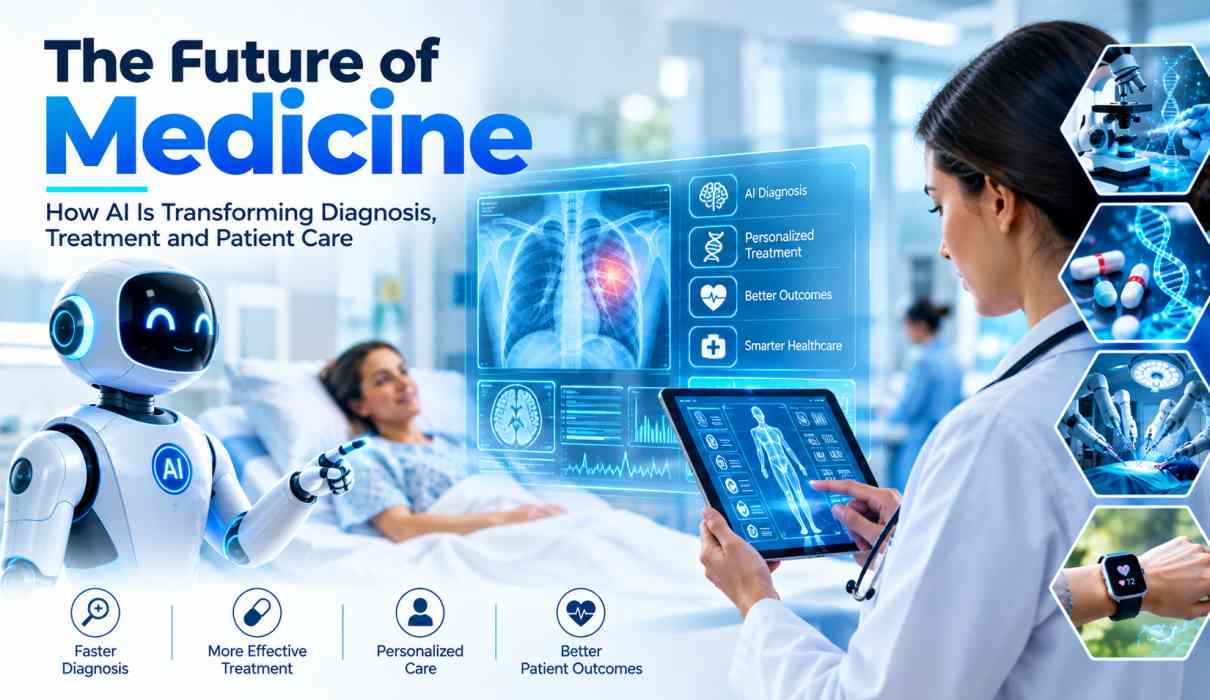
The Future of Medicine: How AI Is Transforming Diagnosis, Treatment and Patient Care
Artificial intelligence is rapidly changing the way healthcare is delivered. From analyzing medical images and supporting diagnosis to accelerating drug research and helping clinicians manage large amounts of information, AI in healthcare is becoming an increasingly important part of modern medicine.
Healthcare has always benefited from technological progress. Medical imaging, electronic health records, robotic systems, genomic sequencing and telemedicine have all changed how doctors diagnose and treat patients. AI represents another major step because it can analyze complex datasets, identify patterns and generate useful information at a scale that would be difficult to manage manually.
The World Health Organization recognizes potential applications of AI across diagnosis, treatment, drug development, disease surveillance and health-system management, while also emphasizing the importance of safety, equity, privacy and governance.
The future of medicine is therefore not simply about replacing traditional healthcare with machines. Instead, it is increasingly about combining artificial intelligence with medical expertise, clinical evidence and human judgment.
1. How AI Is Changing Modern Medicine
Artificial intelligence refers to computer systems designed to perform tasks that traditionally require human intelligence, such as recognizing patterns, processing language and analyzing complex information.
In healthcare, AI can process large datasets containing medical images, laboratory results, patient records and other information. Specialized systems can then identify patterns that may support healthcare professionals in their work.
The U.S. Food and Drug Administration (FDA) notes that AI-enabled medical devices can analyze large and complex datasets and generate information that may support disease detection, diagnosis, treatment and other healthcare functions.
This creates opportunities across several areas, including:
- Medical diagnosis
- Medical imaging
- Drug discovery
- Personalized treatment
- Patient monitoring
- Clinical documentation
- Healthcare administration
- Medical research
- Disease surveillance
- Remote healthcare
AI is therefore becoming less of a futuristic concept and more of a practical technology within the healthcare ecosystem.
2. AI-Powered Medical Diagnosis
One of the most discussed applications of AI in medicine is AI-assisted diagnosis.
Doctors often need to evaluate large amounts of information before reaching a diagnosis. Depending on the condition, this may include symptoms, medical history, laboratory results, scans and other clinical information.
AI systems can analyze certain types of medical data and identify patterns that may deserve further attention.
Medical imaging is an important example. AI-enabled systems can assist with the analysis of images such as X-rays, CT scans, MRI scans and other diagnostic images.
The technology can help highlight potentially significant areas for review, allowing qualified professionals to investigate them more closely.
However, AI output should not automatically be treated as a diagnosis. Medical professionals must consider the patient’s complete clinical situation, and AI systems can produce incorrect or incomplete results.
The most useful approach is often to view AI as a decision-support tool rather than a replacement for clinical expertise.
3. AI Is Transforming Medical Imaging
Medical imaging generates enormous amounts of visual information. Radiologists and other specialists must carefully examine these images to identify abnormalities.
AI can assist by processing images and recognizing patterns.
This can be particularly valuable when healthcare professionals need to review large numbers of scans. An AI system may help prioritize cases or highlight areas requiring closer examination.
The FDA’s current information on AI-enabled medical devices describes applications involving earlier disease detection, diagnosis and personalized diagnostics and therapeutics.
As imaging technology and AI models continue to improve, healthcare providers may increasingly use AI as an additional layer of analysis.
The important point is that the technology should complement professional expertise rather than eliminate the need for qualified medical interpretation.
4. Personalized Medicine and AI
Another major development is the growth of personalized medicine.
Traditional medical treatment often relies on established guidelines that apply to groups of patients. However, individuals can respond differently to the same treatment.
AI can help researchers and clinicians analyze multiple types of patient information and identify patterns that may support more individualized approaches.
Potential inputs can include:
- Medical history
- Laboratory results
- Imaging data
- Genetic information
- Treatment history
- Lifestyle information
- Medication information
Combining these datasets can help researchers investigate why certain treatments work better for particular groups of patients.
Personalized medicine remains a complex field, and AI-generated recommendations require appropriate clinical validation. Nevertheless, AI has the potential to support a more data-driven approach to individualized healthcare.
5. AI Is Accelerating Drug Discovery
Developing a new medicine traditionally requires extensive research, experimentation and testing.
AI can support pharmaceutical research by analyzing large datasets and helping researchers identify potential drug candidates or biological targets.
Instead of examining every possibility manually, researchers can use computational systems to narrow down promising options for further investigation.
The World Health Organization identifies pharmaceutical development and delivery among areas where AI has potential applications.
AI can potentially help with:
- Identifying drug candidates
- Predicting molecular properties
- Studying biological interactions
- Analyzing research literature
- Designing experiments
- Identifying potential treatment targets
However, discovering a promising candidate is only one stage of medicine development. Laboratory research, clinical trials, regulatory evaluation and safety monitoring remain essential.
AI can speed up parts of the research process, but it does not remove the need for rigorous scientific testing.
6. AI and Early Disease Detection
Early detection can be important for many medical conditions because identifying a disease sooner may provide more opportunities for intervention.
AI can support screening and detection by analyzing specific types of clinical data.
For example, an AI system may identify patterns in medical images or other datasets that warrant additional investigation.
The WHO has highlighted AI applications involving areas such as tuberculosis screening and triage, alongside broader uses in public health and clinical care.
The potential benefit is not that AI independently determines whether someone is sick. Instead, AI can help healthcare professionals process information and identify cases that may need additional attention.
7. AI-Powered Patient Monitoring
AI is also becoming relevant to continuous patient monitoring.
Wearable devices and connected medical technologies can collect information such as heart rate, activity levels and other physiological measurements, depending on the device.
AI systems can analyze these streams of information and identify changes that may require attention.
In hospitals, AI may also support monitoring systems by processing patient information and helping healthcare teams recognize potentially important changes.
Outside hospitals, connected health technology could contribute to remote monitoring and virtual care.
These applications may become increasingly important as healthcare systems look for ways to provide care beyond traditional clinical settings.
8. Generative AI in Healthcare
Generative AI has introduced another dimension to medical technology.
Large multimodal models can work with different forms of information, including text and images. WHO guidance identifies potential uses in clinical care, patient-guided applications, administrative tasks, medical education, scientific research and drug development.
One practical application is clinical documentation.
Healthcare professionals spend significant time creating notes, summarizing information and managing documentation. AI tools may help organize or summarize certain information, potentially reducing administrative workloads.
Generative AI may also help with patient communication by explaining complex medical information in simpler language.
However, this area requires particular caution. WHO has warned that large multimodal models can produce false, inaccurate, biased or incomplete information.
For that reason, AI-generated medical information should be appropriately reviewed rather than accepted automatically.
9. AI Can Support Healthcare Professionals
One of the most important questions surrounding AI in medicine is whether it will replace doctors.
A more practical way to view the technology is as a tool that can support healthcare professionals.
Doctors, nurses, radiologists, pharmacists and other specialists make decisions using clinical knowledge, patient communication and professional experience.
AI can provide additional information, automate repetitive tasks and help process large datasets.
This human-AI collaboration could allow healthcare professionals to spend more time on activities that require empathy, communication and complex judgment.
The goal should be to use technology where it adds value while preserving appropriate human oversight.
10. AI and Telemedicine
Telemedicine has expanded access to healthcare by allowing patients to communicate with healthcare professionals remotely.
AI can complement telemedicine by helping organize patient information, support symptom-based conversations and assist with administrative workflows.
For example, AI systems may help collect information before a virtual appointment, allowing clinicians to review relevant details more efficiently.
AI-powered tools can also support translation and communication in some healthcare settings.
However, remote healthcare still requires appropriate clinical oversight. An AI chatbot should not be treated as a substitute for professional medical evaluation, particularly when symptoms could indicate an urgent or serious condition.
11. Robotics and AI-Assisted Treatment
Robotics is another area where AI and medicine increasingly intersect.
Robotic systems can assist with certain surgical and therapeutic procedures by providing highly controlled movements and specialized tools.
AI can potentially enhance these systems by helping process information or support decision-making during procedures.
The FDA regulates medical devices, including AI-enabled medical devices, using a risk-based approach based on intended use and technological characteristics.
As robotics and AI continue to develop, medical professionals may have access to increasingly sophisticated systems for surgery, rehabilitation and other forms of treatment.
12. AI Can Reduce Healthcare Administrative Work
Healthcare involves much more than diagnosis and treatment. Administrative work can consume substantial amounts of time.
AI can assist with tasks such as:
- Document summarization
- Appointment management
- Medical record organization
- Billing-related workflows
- Patient communication
- Information retrieval
- Scheduling
Reducing repetitive administrative tasks could allow healthcare professionals to dedicate more time to patients.
However, automation should be implemented carefully. Healthcare records contain highly sensitive information, so organizations need strong privacy, security and governance practices.
13. Challenges of AI in Medicine
Despite its potential, AI in healthcare also presents significant challenges.
Data Privacy
Medical information is highly sensitive. Healthcare organizations need appropriate safeguards to protect patient data.
Bias
AI systems can reflect limitations or biases present in their training data. WHO has emphasized the importance of equity and avoiding systems that could worsen healthcare disparities.
Accuracy
AI systems can make errors. A confident-looking AI response is not necessarily a correct one.
Transparency
Healthcare professionals and patients may need to understand how and why AI systems are being used, particularly when they influence important decisions.
Regulation
Medical AI requires appropriate oversight. Regulators and health organizations must balance innovation with patient safety.
WHO emphasizes governance, regulation, equity and human rights as important elements of responsible AI adoption in healthcare.
14. The Future of AI in Medicine
The next stage of healthcare AI is likely to involve increasingly connected systems.
Rather than using separate tools for diagnosis, documentation, monitoring and research, healthcare organizations may integrate AI across different stages of the patient journey.
A future healthcare environment could involve AI assisting with information gathering, helping clinicians analyze medical data, supporting personalized treatment planning and monitoring patients after treatment.
Multimodal AI may also allow systems to work with different types of medical information simultaneously.
However, greater capability will also require greater responsibility. Healthcare organizations will need robust validation, monitoring, privacy protections and human oversight.
The future of medicine will therefore depend not only on what AI can do, but also on how safely and responsibly it is implemented.
Conclusion: AI Is Building a Smarter Future for Medicine
Artificial intelligence is becoming one of the most important technologies shaping the future of healthcare.
From AI-powered diagnosis and medical imaging to drug discovery, personalized medicine, patient monitoring, robotics and healthcare administration, the technology has applications across almost every part of the medical ecosystem.
Its greatest potential may come from helping healthcare professionals process information more efficiently and make better-informed decisions.
At the same time, AI is not a replacement for doctors, nurses, researchers or other healthcare professionals. Medical decisions involve context, communication, ethics and human judgment that technology cannot fully replicate.
The responsible future of medicine will therefore be built around human expertise supported by intelligent technology.
As AI systems become more capable, healthcare providers, researchers, regulators and technology developers will need to work together to ensure that innovation remains safe, transparent, equitable and patient-centered.
The result could be a healthcare system that is more data-driven, personalized and efficient—while keeping the patient and qualified medical professionals at the center of care.